A Girl’s Just Got to Dig!

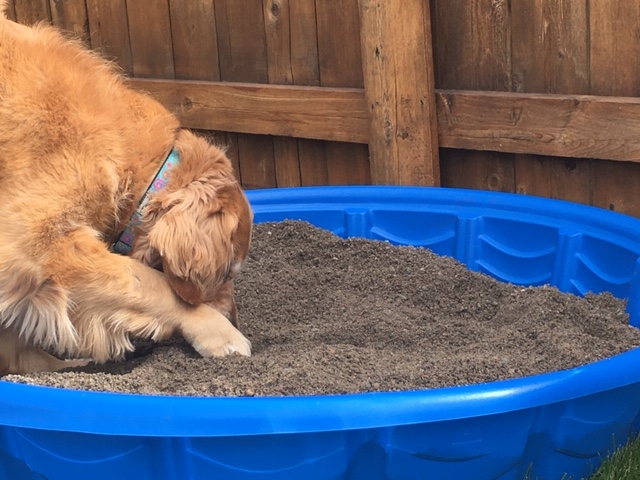
Cali, a golden retriever, digs in the sand in her kiddie pool digging pit

Cali loves to dig. She loves to dig deep holes at the dog beach, sending sand flying. She loves to dig through the snow, sometimes over-zealously sending clods of partially frozen grass and dirt flying.

Most of all, she loves to dig in the yard. The first time we planted tomatoes in our raised garden beds, Cali immediately dug them right back up. She’s since learned that the raised beds are off-limits but … that leaves the whole rest of the yard for her, right?!

I now have two or three large pits in my back yard. Any attempt to refill them is met with more digging.
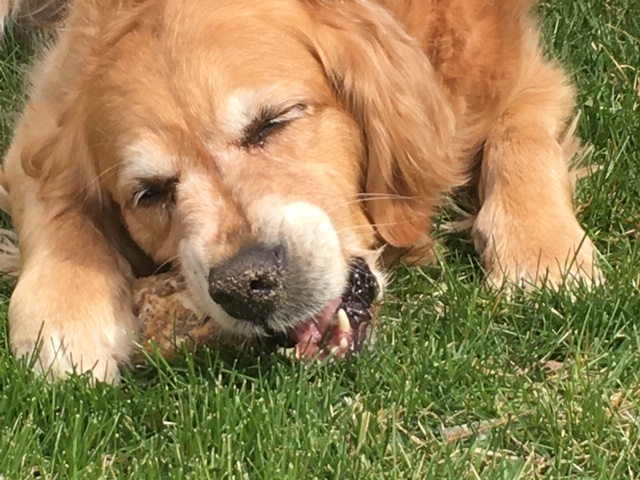
Cali, a golden retriever, enjoys the bone she dug out of her digging pitBut! I have a possible solution. A couple of weekends ago, I built Cali a digging pit. It’s a kiddie pool with sand. I considered other fill materials — wood chips? Pea gravel? I didn’t want something that would get too hot for paws or would harm the grass or the lawnmower if / when some got scattered on the grass.  I thought about getting those plastic balls used in kids’ ball pits but they’re pretty expensive and they squash or puncture easily (not to mention blowing / rolling around the yard!). So I settled on sand. I cover it at night and I don’t get many cats in the yard anyhow with the dogs around.

I bury things — tennis balls, bones.

Koala does not seem to see the point, though she will pull a bone out every so often and gnaw on it.  But Cali seems to like it! She’ll dig something out, chew on it for a while, then wander back to dig for a new treat. As the days grow longer and warmer, we’ll all spend more time outside, so the pit will be uncovered more often. Time will tell whether this diverts Cali from her yard excavations … or simply adds to her digging pleasure.
The Puppy Lunch Saga

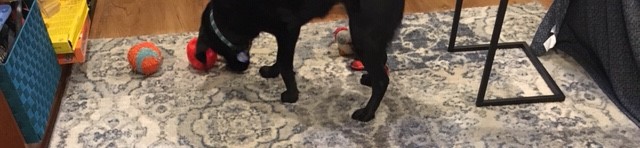
Koala, a black Lab, noses a treat ball in her downstairs play room

For over two years, I opposed Puppy Lunch. I made fun of it and told Deni that Koala had really wrapped Deni around her paw.

I was wrong.

Cali now has Puppy Lunch every day alongside Koala.

Puppy Lunch is a late morning snack. Ideally it would be a mid-day snack, but Koala has adeptly moved the time forward bit by bit, and it’s now generally served at about 10:30. Soon we’ll need to call it Puppy Brunch and perhaps add Puppy Happy Hour at 2 or 3 pm.

But I digress.

Little puppies eat three times a day. Big grown-up dogs eat twice a day — some only once! (Koala finds that very hard to imagine.) The worst day of Jana’s life was the day she grew up and outgrew Puppy Lunch. Cali’s too, apparently.

Koala convinced Deni as well as the Guiding Eyes trainers and nutritionists that she could not possibly survive — much less work(!) — without the sustenance that Puppy Lunch offered.

Cali did just fine without Puppy Lunch.

Then Cali lost some weight and was looking a bit thin. Her vet pronounced her in excellent health but underfed. Cali said, “I told you so!” about a thousand times. Cali’s vet, her favorite human on the planet, suggested … a mid-day meal.

Here’s the part I misunderstood, though: Unlike breakfast and dinner, Puppy Lunch is not simply food poured into a bowl. Puppy Lunch is a small amount of kibble served in a treat ball. Cali and Koala each have an orange treat ball that is used solely for this purpose. Koala brings the balls upstairs; Deni fills them. The girls then bump their balls around the basement play area until the balls are empty. Koala then returns them to the toy box.

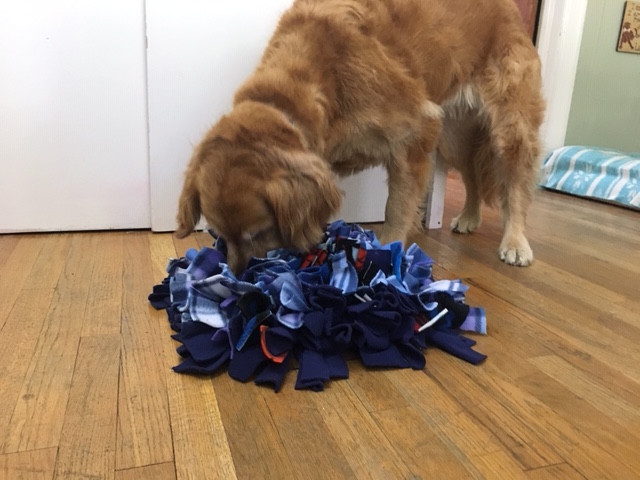
Cali, a golden retriever, sniffs out treats that are buried in her snuffle matIt’s a nice routine. More than that, it’s an enrichment activity. They have fun, use their noses and paws, and get a break in their fairly dull days of watching us work at our computers. Both girls have become skilled at keeping their balls from rolling under things or behind furniture.

Cali often has a second break in the afternoon, with her snuffle mat although, for some reason, Koala rarely joins her. (Hmmm… perhaps Cali has already trained me to provide Puppy Happy Hour …)

When Deni and Koala are working at the university in Florida, Puppy Lunch gives Koala a nice work break and a chance to play in the middle of what can be long workdays.

Cali’s weight is back up to where it needs to be. She’s fit and very healthy. But the routine continues — because adding some fun into her life has been good for her. It’s an easy enough thing to do, especially with Koala reminding one or both of us about Puppy Lunch well in advance…

Dogs to the rescue!

Koala, a black Lab, studies her iPad

I have a confession to make: The real brainpower behind the Thinking Dog blog comes from Koala. She’s shown, above, reviewing drafts of blog posts on her iPad.

She wanted to be sure that no one missed the important news that her distant cousins are going to save humans from themselves by fixing this whole coronavirus mess.

Eight Labradors are learning to use their super power to fight the COVID-109 pandemic: Their noses.

The University of Pennsylvania has a working dog research center dedicated to figuring out innovative ways to partner with dogs. Their latest project is coronavirus-sniffing dogs.

Dogs have already demonstrated their ability to sniff out viruses, which apparently have unique odors — either from the virus itself or from the body’s response — that dogs can detect before an infected person is symptomatic. Dogs are ideally suited for this job. Their detection ability is better by far than available detection equipment, and they can easily travel and work anywhere that humans gather.

Coronavirus-detection dogs could be more accurate than taking people’s temperatures. Their potential to sniff out contagious people who have no idea they are infected could make it safer for people to travel and resume other activities. A similar project in the UK aims to deploy these canine superheroes to airports to screen passengers.

Airports offer so many opportunities for working dogs — I wonder how the vegetable-sniffing dogs, the explosive-sniffing dogs, and the virus-sniffing dogs will all get along. Koala would like to point out that all of these hard-working airport employees deserve potty parity. She’s appalled at the conditions of the airport restrooms she’s expected to use while working and traveling and believes that the dogs who actually work at the airport deserve far better!

Dog Park Kerfuffle

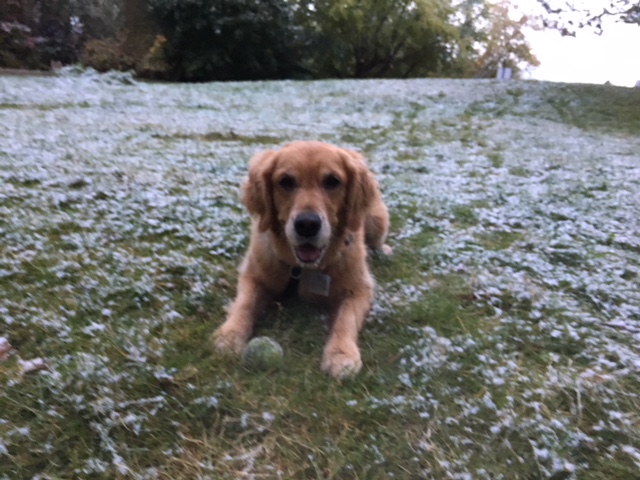
Cali holds her tennis ball at Jacob's Island dog park, early on a cold morning. A light dusting of snow covers the grass.
Cali at Jacob’s Island, a Missoula dog park

Are dog parks wonderful places to let your city dog off leash to safely run and play or are they the potential source of serious problems and likely places to pick up infections, get hurt, or worse?

Yes to both.

It’s been a couple of years since I last wrote about dog parks on The Thinking Dog, and an online exchange about dog parks, brought to my attention by a friend, got me thinking about the topic.

First this New York Times piece came out: The Dog Park Is Bad, Actually. Not much ambiguity there. It’s pretty clear where this writer stands.

A response was quickly forthcoming from Marc Bekoff, a person I have studied with and admire greatly: Let Your Dog Tell You If They Want to Go to a Dog Park.

The NYT piece raises valid concerns, including the risk of disease or injury. I know dogs who’ve been seriously injured by dog-aggressive dogs at dog parks, and a local dog park was recently closed for a week or so for disinfecting after some dogs picked up an infection there.

The author also talks about the idea that dog parks are for “dog socialization” and explains that that’s not where or how to socialize your puppy. True, and also obvious.

Finally, she delves into the issue of dogs who find dog parks stressful or otherwise unpleasant. She closes with this: “There is no shame in not surrendering your dog to what has become the quintessential urban dog experience: running with dozens of strangers in a small, smelly pen as people stand by, looking at their phones or gossiping,” and encourages owners to spend quality time with their dogs instead.

I have been at urban dog parks that are indeed small, smelly pens where the humans ignore the dogs.

But that is not typical of my dog park experience. And I would never go into a park like that with my dog!

Bekoff effectively addresses the sweeping generalizations in the NYT piece while stating what should be obvious: All dog parks are different.

Many are large, open, wonderful spaces, maybe with woods or walking paths.

Dog park culture varies greatly too. In many, there are regular gatherings of people and dogs who are friends. Many dog park people are conscientious dog owners who are actually paying attention to their dogs. Some even play with their dogs! You can and should spend “quality time” with your dog at the dog park!

Many dog parks have quieter times when dogs like Cali, who wants to play with her tennis ball undisturbed by other dogs, can run and roll in the grass and be free. Now that Cali has her own back yard, she doesn’t need the dog park as much … but when we lived in apartments, she really needed the off-leash time and the exercise.

Not all dogs want to play with other dogs, and not all dog parks are wonderful. But they’re certainly not all bad, either. Wherever you stand on dog parks, and whether or not your local options are appealing to you and to your dog, my bottom line is that over-generalizing doesn’t make sense.

You and your dog need to figure out what works for both of you. If you’re lucky enough to have enjoyable dog parks nearby, go ahead — enjoy some outdoor, off-leash quality time with your dog at the dog park!