Dogs Can Get the Flu, Too

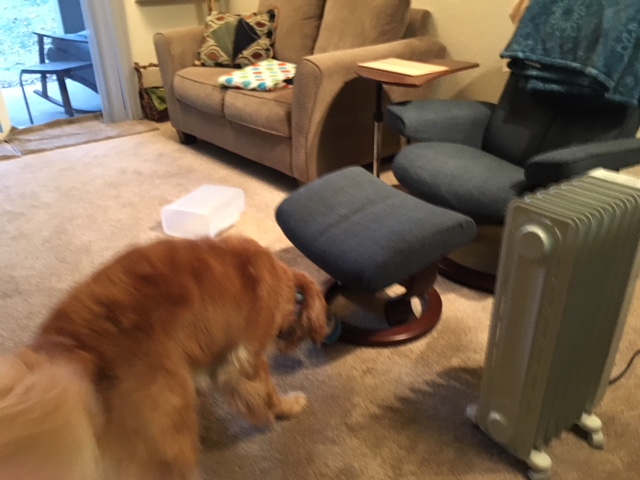
Cali’s not sick; she’s just bored.

Has your dog been coughing, sneezing, and acting lethargic?

If so, get her quickly to a vet; she could have the flu!

Canine flu does not infect humans, but it can spread easily among dogs who come into contact with a sick dog — or an infected toy, bowl, bedding or clothing item, or other object. Dogs can also catch the flu from sick dogs’ sneezing and coughing.

Flu viruses (among many species) change and adapt quickly and also “jump” to new species. One form of canine flu that exists in the U.S. was discovered in 2004 in greyhounds in Florida; it was found to have originated from a horse flu. A second strain of canine flu originated from a bird flu and was first detected in the U.S. in 2015.

Though one or both strains have been seen in most parts of the U.S., the number of cases is still small. If your dog is rarely around other dogs and seems healthy, there’s probably nothing to worry about.

Canine flu is not seasonal, and many dogs show no symptoms. Severely ill dogs can get pneumonia, but that is rare. Canine flu has not spread everywhere in the U.S. yet, but some areas have had outbreaks this winter, including California and Nevada.

Dogs who are frequently around other dogs, at boarding or day care facilities or dog parks, for example might be good candidates for a doggy flu shot (yes there is a vaccine!). Check with your vet. The vaccination requires two shots, several weeks apart.

A Task Only a Dog Could Do

Is Cali a budding search dog?

I heard a great story on NPR recently about dogs helping people. OK, so stories about dogs helping people are nothing new, but this one is different.

I’ve spent a lot of time in Northern California, mostly in Sonoma County not far from where the horrific wildfires burned 5,000 homes and businesses a few months ago. The story was about — stay with me here — trained cadaver dogs helping people whose houses had burned. The dogs were assisting people who had had cremains of family members in their homes.

The dogs are actually able to distinguish the ashes of human cremains from the massive amounts of ash on the home sites.

The forensics expert said that the texture and appearance is different, so, once the dogs alerted to the presence of cremains, the human team was able to separate out the cremains and return them to the families.

A woman interviewed on the show said that her mom had passed away not long before the fires and she’d been planning a memorial service and burial … when the fires intervened. Having lost everything, she was devastated to lose her mom’s remains as well.

Cadaver dog teams came in and the searchers had two dogs, separately, search and alert. If they alerted to the same spot, the humans got busy.

I’m not at all surprised that dogs can do this; I think that dogs can identify and seek out any unique scent, no matter how many other scents are mingled with and surrounding it. I love that people are creative enough — and trust their dogs enough — to come up with an endless variety of ways dogs can help humans do things that, let’s face it, there’s no way humans could do without dogs.

A great book that tells more than you’ve ever wanted to know about training and working cadaver dogs is What the Dog Knows. But it’s not only cadavers … dogs sniff out rare and endangered wildlife (or their scat); living humans; drugs; disease; explosives … anything you can imagine, someone has (or could) trained a dog to find it.

When Cali’s complaining about being bored, I know the problem isn’t with her; it’s my lack of imagination in finding new challenges and games for her. The problem’s hardly ever the dog; it’s the human.

Wipe Her Feet!

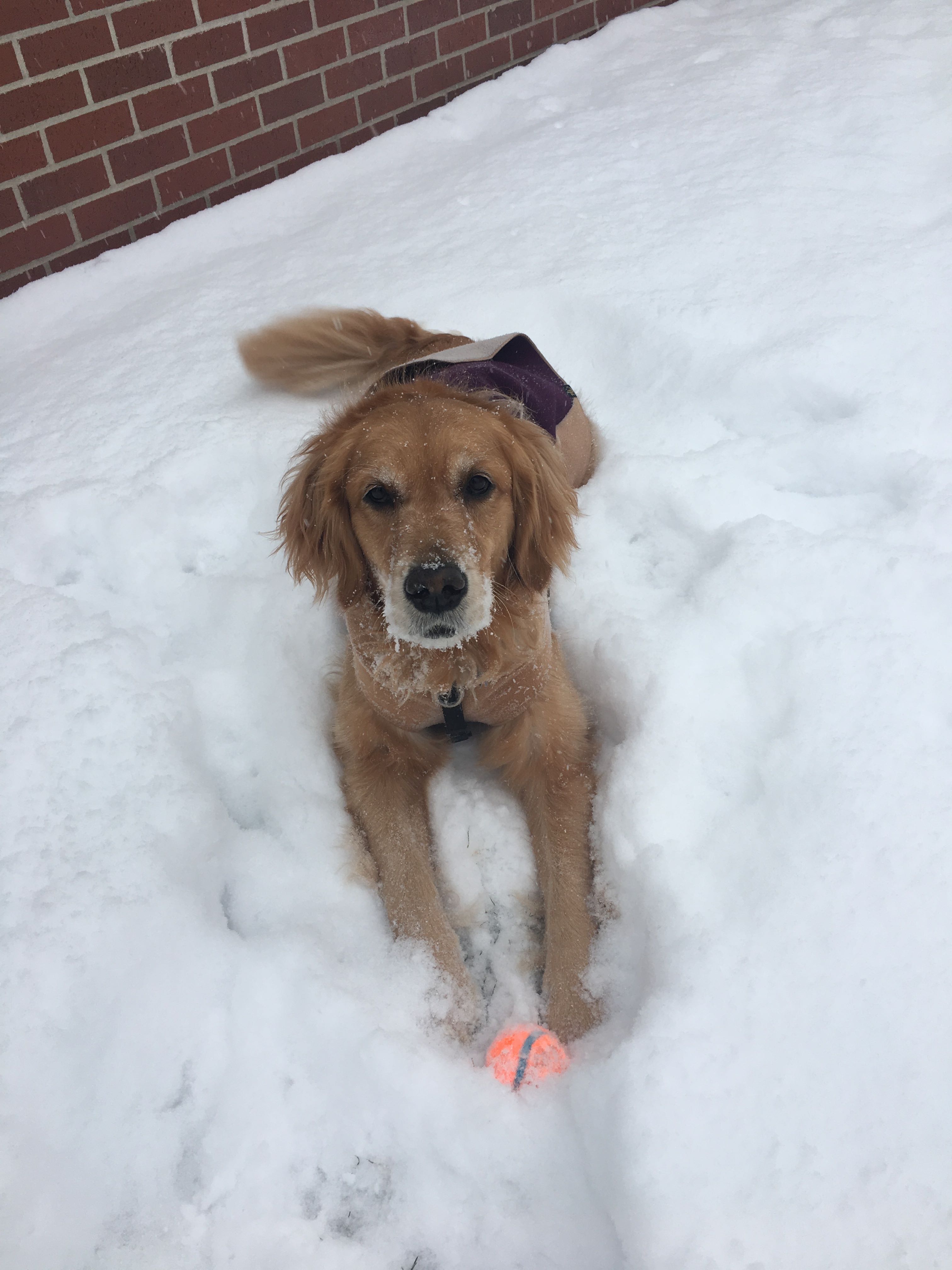
Winter’s back. We’ve had  a pretty mild winter here in Missoula (much to Cali’s dismay), but after a couple weeks of 40s and 50s and melting snow, we woke up to a couple of inches of new snow on Friday.

Actually, I woke up to the distinctive scraping sounds of the guys who zip along our sidewalks on ATVs with mini-snowplows, clearing the sidewalks by 6 am. It’s miraculous.

Cali greeted the new snow with delight and romped around a bit on the “grassy” area by our patio. Once I was fully dressed, we ventured out for a walk. The snowplows are reliably followed by the bucket brigade, spreading blue snow melt stuff. It’s salt and other chemicals.

It’s terrible for dog feet. Some dogs are very sensitive to it; I remember a puppy I was training crying in pain as soon as his feet came into contact with it. Cali’s feet seem tougher, but I am very careful to wipe them with a towel and with baby wipes (organic, natural ones) so that she’s not licking the salty stuff off later.

There are other ways to help dog feet cope with winter:

  • I rub Musher’s Secret into Cali’s feet every week or so. It creates a barrier that protects her pads. It helps protect against hot pavement in the summer, too.
  • For hairy-footed dogs (like Cali), regular trims are helpful. The less hair there is between the dog’s pads, the less the snow balls up and sticks, which can be very uncomfortable for the dog.
  • For dogs who walk on snow, snow-melt chemicals, and ice often, boots are a good idea. Most dogs dislike this idea, but they can often be convinced (bribed) to wear their boots.
  • I haven’t tried this yet, but I’ve heard that vet wrap — that stretchy elastic bandage wrap that comes in bright colors — can be wrapped around the feet to improve traction and provide a barrier to the ice and chemicals.
  • If you take care of your own sidewalks, choose pet-safe snow melt. It’s more expensive, but less caustic to the pup’s feet.

Do you have other tips? Please share!

Have a safe and FUN winter!

Every Dog Needs a Hobby …

Cali is often bored. I work from home, so I spend several hours a day at the computer. Cali finds this tedious, and often suggests alternative activities. She’ll bring her ball in and suggest a game, for example. But she has also taken up a couple of pastimes on her own.

When we were still living in Petaluma, Cali (and Jana) loved spending their days out in our little yard while I worked. I put up a bird feeder, and we soon had a large flock of regular diners. They’d scatter instantly if I came out, which I found a bit hurtful. I was the one who bought and served their meals, after all. They’d settle back in to the feeder if I sat outside quietly, though, so I forgave them. They never minded the girls, though. Cali could come and go as she pleased. She spent many hours with her bird friends.

Here in Missoula, I put the bird feeder up near our patio. Cali has to watch from inside, but she lies on the carpet by the sliding patio doors and watches the birds. There’s a chubby squirrel who often pays a visit, and Cali gets very agitated. She’ll run to the office; I’m not sure if she’s trying to look out the window here or just tell me what’s going on, but she runs back and forth, panting. So I get up and chase the squirrel away. This happens three or four times and then the squirrel gives up for a few days. He always comes back, though. I suspect that he has several bird feeders, perhaps all equipped with tormentable dogs. In any case, he’s quite well fed.

The birds do not fly away when Cali is there, or when she comes and goes. But, like the Petaluma birds, as soon as I walk into the living room, they disappear. When I go out to refill the feeder, there’s not a bird in sight. They’re close by, though. They reappear within seconds after I go back inside.

When the birds leave, Cali moves to the bedroom. From the bed, she can watch the comings and goings of everyone in our building. She’s always sure to let me know when UPS or FedEX is about to knock on the door, but, unless another dog spends too much time standing outside our window, she’s content to watch quietly.

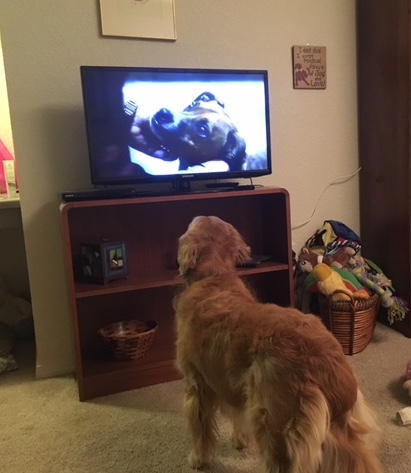
Cali’s other hobby is watching dog and wolf shows on TV. She’s sometimes interested in other nature-themed documentaries, but, really, it’s wolves and dogs. The other day, I was fiddling with a new digital antenna and managed to tune in PBS, crystal-clear. A show on arctic wolves was on. They were eating (I was not, thankfully). Cali ran in from the bedroom and sat right up in front of the TV, mesmerized. My mom always told me not to sit that close, but I didn’t think that a few minutes of watching would harm Cali’s eyes. As soon as the wolves were replaced with people, Cali lost interest.

Then, a few days later, I got a text message with a video of Dora (Cali’s sister) playing with her friends. As soon as Cali heard Dora’s bark on the video, she came running into my office. I held the phone where she could see it, and she was again, fascinated. I don’t know that she recognized Dora (maybe!), but she was certainly interested in watching the dogs play.

Cali’s great aunt, Oriel, used to love watching TV. Jana was not much of a TV girl. I’m really curious about what the TV watchers are thinking. And, who knows? Maybe Cali will improve my viewing habits. She’s shown no interest in Grey’s Anatomy, for example. Maybe I need to watch more PBS documentaries, just to spend more quality time with my dog.