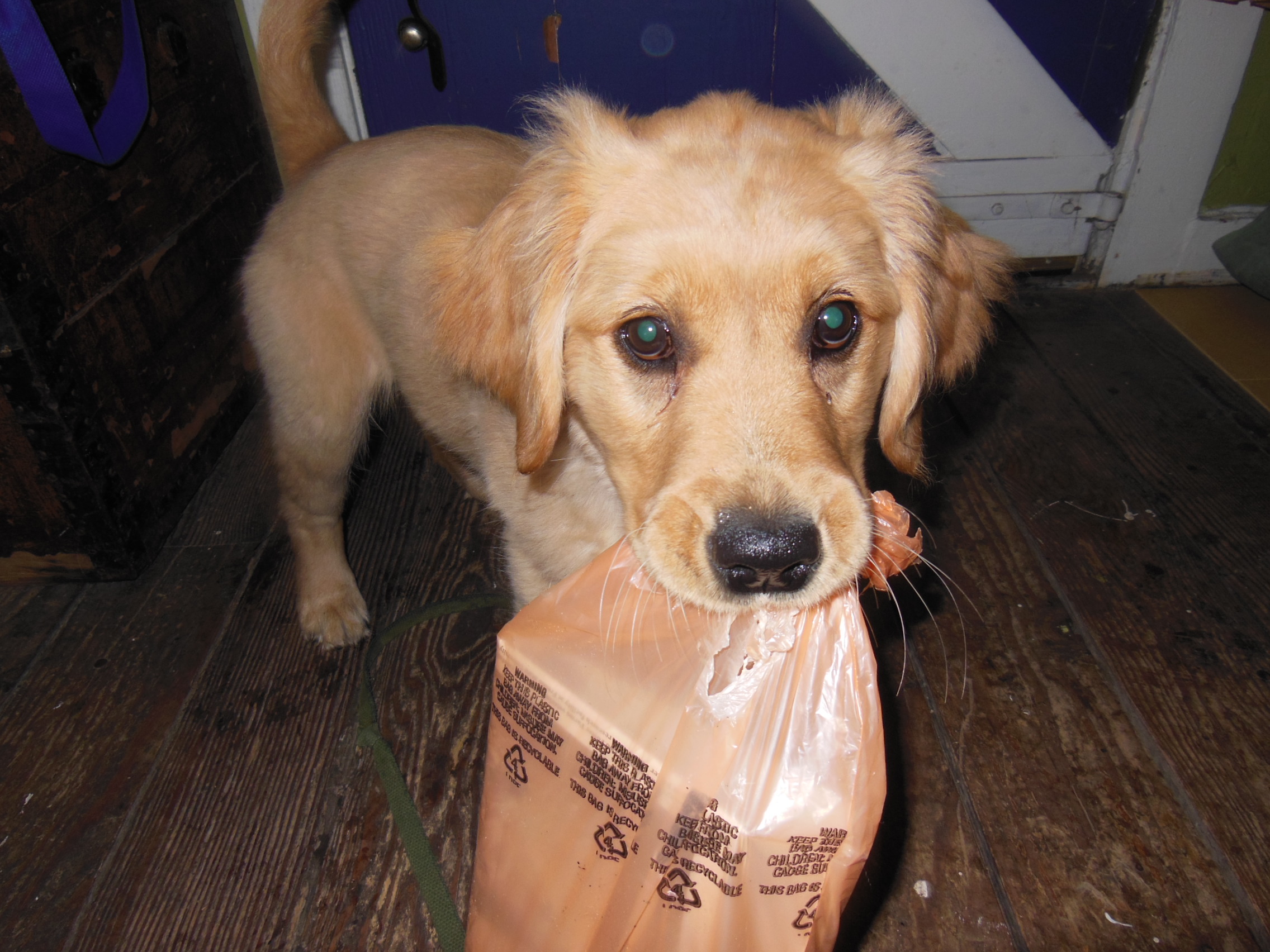
Koala, Deni’s current guide dog, is an exuberant dog; she has greeted me so enthusiastically that I emerge bruised. When she finds Deni a trash can to dump her poop, Koala leaps up and embraces the can, entire body wagging. So I was skeptical that she’d do well on the marshmallow test.
The marshmallow test is a test of self-restraint. The original test pitted preschoolers against marshmallows: If the child, unsupervised, could hold off on eating a marshmallow for 15 minutes, the researcher would reward the child with a second marshmallow. Children who waited, rather than eating the marshmallow with which they were left alone, were found, as adults, to have achieved greater success according to a variety of measures: higher SAT scores and greater academic achievement, more likely to have saved for retirement, etc.
Alberta, Deni’s previous guide dog, as you might recall, did very well on the marshmallow test. She clearly worked to distract herself from the treats, employing some of the methods the children did: she turned away, closed her eyes, raised her head and closed her eyes. Some of the kids sang or hummed; Alberta raising her head to smell something other than the treats is probably the doggie equivalent.
Alberta is, in many ways, a less exuberant and more restrained dog than Koala. So, I did not expect Koala to fare as well on this test of self-restraint.
Deni set up Koala’s test just has she had Alberta’s. A bowl of dog cookies was placed in the quiet hallway outside Deni’s office; Koala, dressed in her guide harness, sat in front of the bowl. Deni told her to “leave it,” then Deni went into the office and closed the door. Koala was alone in the hallway, but Deni, and a student photographer watched through the window blinds. Koala could not see Deni.
While Deni and the student were setting up the test, filling Koala’s bowl with treats, Koala — in harness — leapt and bounced around them in excitement. The student commented that she did not think the test would end well for Koala.
So, how did she do?
As Alberta had, Koala first leaned in and sniffed the cookies. She sat back up. And sat there. Unlike Alberta, she sat and stared at the bowl, salivating a bit. That’s it. She did not have to distract herself, she did not look away, close her eyes, or sing to herself. She aced the test.
I might need to point out: Both girls are Labradors who love their food and adore cookies.
Why was the test easier for Koala? Both girls were able to fight temptation and exercise self-restraint. What’s her secret? I’d love to say that her analytical nature is the key, but being very analytical myself has never helped much in the face of a chocolate-chip cookie.
Is Koala simply on a higher ethical plane than Alberta is (or I am)? That is the question that Deni is now asking: Is Alberta more ethical for having overcome a struggle to exercise restraint? Or is Koala more ethical for being easily able to do the right thing? Deni asks her philosophy students the same question about people.
We may never have an answer to that. What we do learn from this test, though, is that a dog’s behavior is not evidence that that dog can (or cannot) learn to “behave” —exercise self-restraint — in other circumstances. Koala, for example, plays tug to win, big time. She’d rip your arms out of their sockets if you let her. But her ability to “leave it” shows that, with practice and reinforcement, she could exercise that same restraint in other areas.
For other dogs and people, that translates to not giving up on a dog who has some uncontrolled behavior; it’s likely that, with some coaching, time, and practice, that dog, too, can pass his own marshmallow test. Now I am curious about Cali …