It doesn’t matter if the day is cold, gray, and rainy, as it was all of last week. Or if I left Cali home alone for a few hours, which she protests with pouts. Or that I have been very preoccupied with work, and therefore I have spent far too much time staring at a computer screen this week. Cali dances.
Cali is a happy dog.
If a guest comes over, she rushes over to say hi. Then she grabs a toy — the three-legged lamb in this video and her enormous earless pink owl are current favorites — and dances around the living room. (If the visitor is someone she really likes, a concert of overjoyed squealing introduces the dance.)
Cali also does this dance first thing each morning and every time I come home, even if all I did was walk across the parking lot to throw out a bag of trash. She occasionally breaks into spontaneous dance at other times of the day.
When I am on the phone, she might do this dance or her other specialty, which entails lying on her back and bicycling furiously with her back legs to propel herself around the room. The hope is that I will laugh so hard that I have to end the call and pay attention to her. Oddly, it works pretty well. Unfortunately, I have never been able to capture the upside-down bicycle dance on video.
Cali is a happy dog. She shares this joy with all of her friends, by which I mean every human being she has ever met (or walked past) and most dogs that are smaller than she is and who have not tried to steal her tennis ball.
So, rather than spend any more of this unbelievably beautiful fall day inside, staring at a computer, I am going outside with my dancing girl to enjoy the sun. Have a joyous week.
Can dogs be narcissistic? I never wondered about that until I got to know Koala.
Let’s back up a bit. To be a narcissist, a dog would have to have a concept of herself as an individual. Some people say that dogs don’t have “self-awareness,” the knowledge that they exist as unique individuals, separate from the environment and from other individuals.
Dr. Marc Bekoff, an ethologist and retired professor, thought that was absurd and set out to show that dogs do have self-awareness.
A common test for self-awareness is what’s often called the mirror test. The test subject is marked with a dot on the forehead, but he is not aware that the mark is there. The test measures whether, when he looks in the mirror, the test subject touches the dot on himself. If so, that indicates (supposedly) that he knows that the mirror reflection is an image of himself, and that (supposedly) shows self-awareness. Humans, even very young ones, generally pass this test. Dolphins do, too. But dogs often do not.
Now, I’ve known several dogs who would conduct complex communication with me or another human (or dog) via a mirror. Those dogs absolutely knew that the reflections in the mirror were theirs, mine, Deni’s, whoever’s. Leaving that aside, the mirror test is a poor test of self-awareness for dogs because recognizing self or others by sight simply isn’t that important to them. (I could go off on a long rant about tests set up by and for humans based on human abilities and values that are then used to “prove” that nonhumans lack those abilities … but I won’t.)
What matters to dogs is smell.
So, back to Bekoff. He knew that the mirror test was a lousy instrument for testing dogs’ self-awareness, so he came up with a scent-based test: the yellow snow test. One Colorado winter morning, Bekoff let his dog out to do as dogs do. Then, when the dog wasn’t watching, Bekoff scooped some of the yellow snow and moved it to a location that had been visited by other dogs doing their morning business.
Then, Bekoff let his dog investigate. We all know that dogs love to check the pee-mail on walks. Bekoff’s dog was no different. Bekoff’s idea was that if a dog recognized his own scent, he’d pay less attention to it than to the scents of other dogs — dogs he wanted to learn about.
Bekoff was right. His dog passed the pee-sniff test. So did several other dogs Bekoff tested.
After learning about this experiment, I watched my own dogs’ behavior. Sure enough, they’d take a quick sniff at their own spots and move on, lingering only over other dogs’ leavings. Until Koala.
She reliably checks out her own stuff. She’ll investigate her spots later on, just as a less self-absorbed dog would check the news of other dogs. I’ve seen a few other dogs do this; Jana liked to revisit her prime spots on later walks. But Koala isn’t looking for news of other dogs, even if they’re talking about her.
No; Koala does something I have never seen another dog do: As soon as she’s done going, she turns and takes a long, approving whiff. If a fascination with oneself is the definition of a narcissist, I am afraid that Koala qualifies.
She’s not only focused on herself; she is quite interested in meeting people — and figuring out how she can get them to do things for her. That’s not entirely fair; Koala is an outstanding guide dog. She’s also silly, high-energy, and quite eager to meet and play with other dogs. But she may be the first canine narcissist I have ever met.
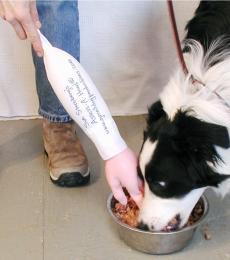
A recent New York Times article talked about a common test that supposedly assessed dogs’ aggressive tendencies. The test uses a fake hand, called an Assess-A-Hand, to “determine” whether a dog will aggressively protect his food bowl.
The idea behind it is fine; who wouldn’t want to know whether a dog is aggressive? But the idea that a single test, lasting a couple of minutes, could tell you that is absurd. The article quotes one shelter staffer as saying they’d thought of the test as a “magic bullet” and another justifying using it by explaining that “anxious adopters” need “assurances” that the dog won’t bite or react badly to other dogs.
No shelter person, breeder, dog trainer, or other dog professional should ever provide “assurances” about any dog’s future behavior. Nice as it would be to have those assurances, if you want a guarantee that your dog won’t bite, you’d better get a stuffed animal.
Part of the problem with the Assess-A-Hand tests is that people administer the test very differently. Poking the Hand into a bowl, maybe bumping the dog gently — that is how the test is intended to be used. But I have seen people actively poke and prod the dog, escalating until they provoke a reaction. Not fair.
In either case, though, the test does not provide any deep insight into the dog’s personality and certainly no way to judge future behavior. Spending time with that dog and watching his interactions with people and dogs will tell you a lot more. And taking any dog into your home means taking on some risk. There are no guarantees.
The responses to the article are interesting snapshots of the spectrum of attitudes toward dogs, from those who argue that any dog, even a repeat biter, deserves a chance to those who say that no dog who has ever bitten should be accepted into a shelter. I don’t think that either extreme is reasonable, whether it’s condemning a dog based on a single flawed test or arguing that no dog is unadoptable. I do think that a dog’s history is far more revealing than a test administered at a stressful time in a scary place to a dog who may have been hungry for days.
The bottom line, though, is that we humans need to stop seeking magic bullets. There is no simple, two-minute solution to the problem of hundreds of thousands of homeless dogs, some with long histories of biting people. There is no test that can tell you what any individual’s behavior will be in myriad unknowable future situations. We should focus on ourselves: find the time to get to know our dogs and teach children how to behave around dogs. That would be more productive than looking to simple tools like the Assess-A-Hand to perform miracles.
Cali and I recently moved to Missoula, Montana. We enjoyed our first five or six weeks there with endless clear blue skies, long sunny days, and cool nights. Then fire season arrived.
Montana is having the worst fire season in history, and a huge fire is burning not far from Missoula. Friends and family were among the 1,000 families that had to evacuate … and thousands of pets and livestock evacuated as well.
Then, just as those families were slowly being allowed back home, a natural disaster of an entirely different type hit far south of us: Harvey. Tens of thousands of people and pets evacuated … to where?
During the weeks of the most intensive fire activity, two local organizations helped with Montana pet and livestock evacuations. The county animal control office commandeered barn and stall space at the fairgrounds for horses, cattle, sheep, goats, and chickens. The shelter also accepted some chickens, other small animals, and of course, dogs and cats. The regional SPCA took in pets as well. But both organizations also maintained lists of local families willing to foster animals. This could mean taking in a dog or two — or offering pasture space for horses. A local Facebook page set up by a community member played matchmaker as well, connecting people who needed horse trailering with people who had trailers to lend, for example, as well as matching up need and supply for pastures, places to set up RVs, etc. Several area businesses offered kennel or barn space. I loved the way people in the area stepped right up, offering whatever they could.
From news reports, it looks like shelters across Texas also are pitching in to help care for evacuated pets, but they will need more aid than the local community is able to offer.
How can we help?
I dropped off two carloads of dog and cat food and kitty litter to the Missoula Animal Control. Both local organizations had “wish lists” of needed supplies. The local ACE store offered to keep a sort of “gift registry” — a list of needed supplies, since so many customers were asking staff what the organizations needed.
The fire evacuations were short term; fortunately most people got to go home to intact houses (two families did lose their homes and others lost outbuildings like barns). But the aftermath of Harvey is several orders of magnitude larger. Anyone who is close enough and has space might offer to foster pets or transport pets to shelters or foster homes. I keep hearing that the organizations need donations of money more than of goods, and that deliveries of goods are not necessarily getting through yet. The need will last months or even years, so anyone who can afford to might consider regular donations for the next several months.
But as important as helping with the current need is planning ahead. Does your local shelter have a disaster plan? If not, maybe you can help them create one. Do you have the ability to foster evacuated pets? Maybe you can help a local organization start a list of local people who can help out in emergencies. What if you are affected by the next extreme weather disaster: Do you have an evacuation plan for yourself and your pets? Where would you go? Do you have crates to transport cats and smaller pets?
After Katrina, many organizations put together plans and advice for people with pets, and Harvey is a reminder to update our plans. Here are some resources that can help you get started: