Martin Speaks for “Everydog”

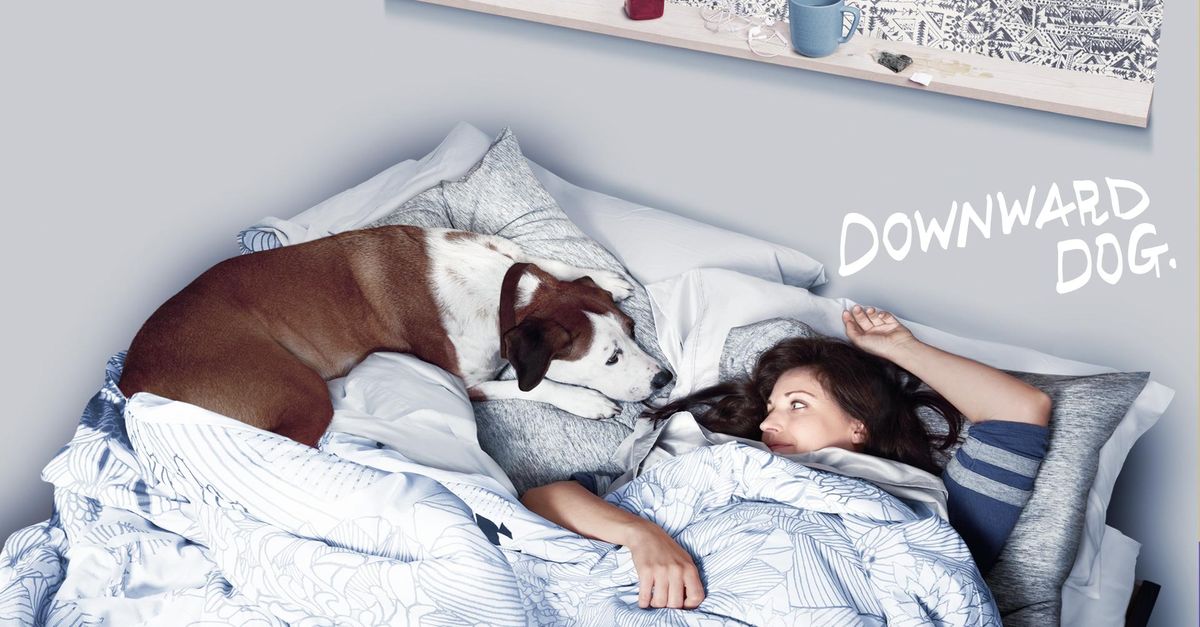
An ABC promotional image for “Downward Dog”

If you’re not watching ABC’s “Downward Dog,” you should check it out before it disappears. (ABC just announced that the show will be canceled after its seventh and eighth episodes air this week.) Martin, the narrator, does a pretty good job of capturing the cynomorphic take on the human-dog relationship. That’s the dog’s point of view.

Martin, a medium-sized mixed-breed dog, shares a home with Nan, a single woman with a demanding advertising career, an unreasonable boss, and a frustratingly immature and undependable on-again, off-again boyfriend. Martin chronicles the ups and downs of their relationship and his days.

While he might not speak for every dog in every instance, a lot of what he says rings awfully true: His assumption that Nan drives around all day in her car and his inability to understand why she’d want to do that without him; his hurt when he finds out the truth. His certainty that he has super powers when he can make the automatic dog door open (one of our dogs seemed to have the same take on it; the others either thought it was magic or just another way the lazy human staff tried to get out of doing their jobs; Cali thought a trainable ghost ran things). His conviction that he makes the rules in the relationship and sometimes has to show Nan who’s boss — by chewing up an Ugg boot.

One of my favorite parts so far is Martin’s soliloquy on why he is compelled to eat trash. I could just see Jana, my ultrafeminine princess who loved to roll in dead things, nodding in agreement. Sometimes, a dog’s gotta do what a dog’s gotta do.

The show doesn’t get everything right. For instance it leans too heavily on the assumption that, in a dog-human relationship, someone has to be “dominant.” And Nana’s character embodies way too many clichés about single women. But, though Martin is self-involved — like many dogs — he’s a lovable guide to the dog’s world.

I’ve spent years trying to understand how dogs see our relationships with them; I’ve tried with mixed success to teach students to consider the many angles and nuances of life with dogs from the dogs’ point of view. If I were teaching those students now, I’d use the eight episodes of “Downward Dog” as an imperfect but enjoyable presentation of one dog’s unique perspective.
Two Rude Jerks Go Out For a Walk

As Cali and I were walking to the park, we saw a woman with a small terrier-looking dog. I said hello and she did too. Cali was taking a long sniff of the grass near some trash bins, so I moved aside to let them pass.

As we walked behind them, I noticed that the little dog kept picking up his rear right paw. He had impeccable leash manners, which means that the woman wouldn’t be able to see his back paws, since he was walking right next to her (paying attention, Cali?). Also, despite a lot of rain this winter, dry season has arrived. Stiff grass stubble is everywhere, as are foxtails. Cali comes home from walks full of tiny burrs. In other words, prickly things that could easily get embedded in a paw are everywhere.

So I said to the woman, “Your dog is picking up his paw; he might have something stuck in it.”

Her reply: “I’m a good pet owner.”

Is it me or was that an oddly hostile and/or defensive response? Quashing the impulse to say something defensive in return, I said, “I thought he might have a thorn or something in it. That happens to my dog a lot around here.”

She softened a little, I think, and told me that her dog has a congenital knee problem and that’s why he does that.

But, really, is the assumption that I am criticizing your parenting the go-to response for most people? That’s a sad comment on society.

Or maybe it is me. Because, a few blocks later, we encountered another dog walker. As I tend to, I detoured into the street to avoid passing close to an unfamiliar dog on a narrow stretch of the sidewalk. The other walker said, two or three times, “He’s friendly.”

When we were closer, I said, “My dog is nervous around unfamiliar dogs.”

All perfectly normal … except the implication that I was assuming negative things about her dog. Do I radiate an air of disapproval and judgment? (Please do not answer that question.)

The last encounter in this bizarrely social morning was at the park. This time, Cali was the jerk, running off an overly friendly poodle who showed too much interest in her ball. The joke was on Cali, though, because, while she was running him off and then I was reprimanding her, Maui, a dog Cali used to consider a friend, actually stole her ball. We beat an embarrassed retreat before she could challenge Maui to a duel.

I am going back to 7 a.m. walks; the park is empty and the other dog walkers are also trying to avoid dog encounters. That all makes it easier to avoid offending the entire dog and dog-owning population of Petaluma.

Hero for a Day

No breakfast is always a bad sign.

Cali pokes me hopefully with her nose. Remember me? I’m hungry. I hug her and apologize. It’s your Morris Study Day, I tell her. I promise her a really good breakfast after the exam.

We head to the vet. For once, everything goes smoothly. No traffic (!). They take Cali immediately. No emergency comes in to delay taking the endless samples — the usual stuff, plus blood, fur, toenails. I assure the vet that I have not touched Cali’s nails since her March grooming. Her nails are always so short that it’s hard to get a sample. This year, at least her dewclaws are long.

As we’re talking, I realize that I completely forgot to collect samples on our morning walk. Not a problem, the tech reassures me. We’ll get them. I tell Cali she’d better poop for them. You can’t get out of here until you do, I tell her. That means no breakfast until you poop. She poops. She eats lots of treats. In fact, she’s done in an hour. Hooray!

Cali has breakfast. We play ball for a few minutes. She’s fully recovered. She also gets a special treat at dinner (sardines). Definitely recovered.

But every year, I wonder: Is this process OK with her? She’s happy but also a little nervous at the vet clinic. She’s been clingy since Jana died several months ago, and at the vet’s office, she “ups” on my lap and snuggles in. Sweet, but also a sign that she’s not comfortable, mildly stressed. At this vet office, the techs collect samples “in the back,” — away from my sight. I trust them; I know they are not hurting Cali any more than necessary to get a blood sample or clip her nails. But she’s nervous; she hesitates for a second before running after the tech who’s leading her away.

Every year I go over and over this in my head. It’s not that different from a regular exam, which I would do every year even if Cali were not in the study. The study is collecting a huge amount of data that might point to ways to reduce canine cancer. That is a big deal. I believe in what they are doing. I trust the vet and techs at this clinic. Is all of that enough? I decide it is.

But what does Cali think? She’s so easygoing and forgiving that she seems to just shake it off. She enjoys the extra attention and treats both at the clinic and once we get home. But her nervousness haunts me.

The Morris Animal Foundation Golden Retriever Lifetime Study started enrolling dogs shortly before Cali was born (she’s four and a half). The oldest dogs who were eligible were two. That means that none of the 3,000 “heroes” are older than seven. Some have already had cancer; some have already died. This study matters. I know too many golden retrievers and other dogs who have had cancer, including some very young dogs. The study looks at genetics, exposure, diet, lifestyle. We (the human participants) fill out a very detailed questionnaire every year. What we feed our dogs, including occasional treats and supplements. How much exercise they get. What they’re exposed to: Pesticide? Secondhand smoke? It’s all in there.

The research team will have an enormous amount of data. I am looking forward to seeing what they find. I hope they look at other things besides cancer and that they release information about what they’re seeing already, about five years in.

But so far, after Cali’s fourth visit, I find myself wondering more than ever what she thinks of it all.

It’s All About Strategy

I recently wrote about how Koala uses tools, using a round chew toy as a base and holder to position a more desirable chew (an antler) for better chewing. But there’s more to her entertainment strategy than tool use.

Although she is a two-and-a-half-year-old working adult, Koala still gets puppy lunch. This is a point of contention in the family, because Jana thought she should get puppy lunch forever (but I did not agree), and Cali thinks, not unreasonably, that if Koala gets puppy lunch, she, too, should get puppy lunch.

What is puppy lunch, you ask. Large-breed puppies, because they are growing quickly, get three meals a day. Adult dogs, who only grow wider, get two (and in some cases, one!) meal a day. Puppy lunch is the mid-day meal that goes away when a dog is about a year old. Unless she’s Koala.

The first puppy-lunchless day is a day of infamy and trauma in the lives of goldens and Labs everywhere. Jana never really recovered.

Koala’s puppy lunch is a portion of kibble, served in a treat ball. The ball gets rolled and batted around, dribbling bits of food for Koala to munch. It’s fun. I have several treat balls, and sometimes give Cali food in one. She gets bored with it far more quickly than Koala, partly because she’s less food-focused. But Koala really enjoys her mid-day snack-and-play breaks.

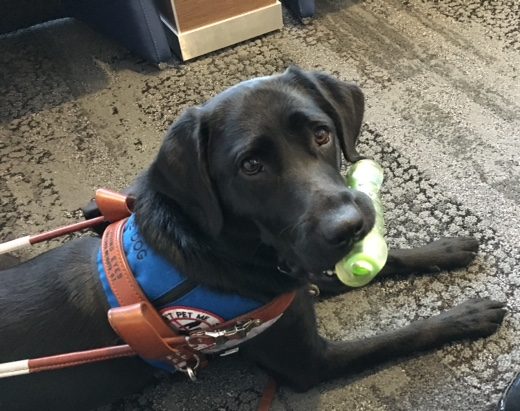
All of that background offers the context for Koala’s strategic play approach. I was watching her eat her puppy lunch not long ago and I saw her using a fairly sophisticated tactic. We were at a hotel (at the Guiding Eyes weekend, actually) and the room had a dresser, sofa, bench, bed, etc. Lots of places a ball could roll out of reach. Koala is an exuberant dog, never more so than when playing, so the ball was getting batted around at a good clip. But it was not uncontrolled ball batting. She’d pounce, roll the ball, whap it with a paw … but always, always keeping track of the many sand-trap equivalents. Never once did she let the ball roll under or behind something. She’d pounce on it or bat it just in time, sending it in a different direction. She almost seemed to be gauging how close it could get to the edge of the bed, say, before she’d lose the ability to steer it out of danger. She’d watch, position herself, and, bam, send it careening away toward the next potential obstacle. It only takes her about 10 minutes to empty the treat ball, so this high-stakes bowling / golf game took place at an impressive level of intensity and speed. She’s really good at this entirely made-up game.

This is certainly not the first time that I’ve seen a dog play a game that she has created. What held me spellbound was both the intensity and the advanced strategy. She had an intuitive understanding of a fluid situation. Much as dogs do when they catch a Frisbee or dive into a river at the precise moment needed to grab the ball or stick as it floats by, she showed a far better grasp of physics than I ever could.

The geneticist at Guiding Eyes says that each generation of their dogs is “better” — smarter, more suited to guide work, healthier — than earlier generations. If the dogs get any smarter than Koala, we won’t need to worry about robots taking over our jobs; the dogs will beat them to it.