Apologies to Jana

I owe Jana an apology.

I’m reading a wonderful book (go get it right now!), Beyond Words by Carl Safina. A review will be posted … once I finish the book. I’ve finished the sections on elephants, wolves, and, best of all, dogs. Orcas are up next.

He takes great delight in lampooning several ludicrous studies that purport to prove humans’ superiority in matters of self-awareness and “theory of mind.” In reading Safina’s analysis of the mirror test, I realized that I got it all wrong. His explanation is brilliant — and so obvious.

The mirror test has been used for decades to establish, so some researchers say, whether an animal has self-awareness. This is variously defined as recognizing that you exist as an individual separate from other individuals (and your environment) to, more absurdly, the definition put forth by the creator of the test and quoted in Safina’s book: “Self-awareness provides the ability to contemplate the past, to project into the future, and to speculate on what others are thinking.” Other definitions include the “capacity for introspection.” I’m not sure how recognizing yourself in the mirror reveals a capacity for introspection or an ability to project into the future, but the folks who wrote those definitions did not explain that detail.

The test involves surreptitiously putting some sort of mark on the test subject’s forehead. When the person (whether human, ape, dolphin, dog, etc.) looks in the mirror, if the person touches or tries to remove the mark, he or she is recognizing that the reflection is not some other creature but an image of himself or herself. I understand that. What Safina points out, though, is that that says nothing at all about self-awareness. What it reveals is an understanding of how reflection works. Seems pretty obvious, no?

He goes on to talk about what self-awareness really means — being aware that you, yourself, are separate from other “selves” and from the environment. He says that a creature that does not recognize this would assume that the reflection was itself since it would not differentiate its own “self” from anything else, but that would also make it impossible to move, eat, find a mate, or do much of anything, like survive. He provides wonderful examples of all kinds of non-humans showing exquisite understanding of their environments and other beings that populate those environments.

I’ll leave his discussion of theory of mind for another post.

So, what does all of this have to do with Jana? In a long-ago post, I described Jana’s experience with the mirror test, and I described her as not only self-aware but also as self-absorbed. While this might be true, I did not give her enough credit. You see, Safina points out that what some non-humans (and who knows, maybe some toddlers as well) do when they first encounter mirrors and do not (yet) understand reflection is that they try to engage with or attack the other being in the mirror. While many psychologists will say that this means that they are not self-aware, Safina makes the (again obvious) point that it absolutely shows self-awareness. Trying to play with or attack another being requires that understanding that you and he are not the same creature!

So. Jana. When Jana was a puppy, we had an older dog, Timo, who resented the puppy and did not play with her. My mom had two adult dogs, Buddy and Daisy, who also were not keen on playing with this relatively large, high-energy puppy. But at my mom’s apartment, Jana made a wonderful discovery: a puppy who kept play-bowing and acting friendly and excited to see her. Jana could not understand why this other puppy never moved beyond the play bow, however. Within a few weeks, Jana did recognize that the puppy in the mirror was actually her, and she stopped trying to get the puppy to play. I used to tell this story and say it meant that little Jana didn’t yet have self-awareness. How wrong I was!

Thanks, Dr. Safina, for pointing out that of course my brilliant puppy knew that she was a distinct individual — an individual who simply wanted a playmate.

 

Canine Con Artists?

I originally wrote this post for PPG Barks, the blog of a professional positive trainers networking organization. The post was rejected; I think the reason is that I am asserting that dogs deceive each other and humans. I am  very interested in this topic, and I plan to revise the post further (or write an entirely new post) about dogs and deception. Meanwhile, I’d love some feedback from you. Please comment on the post or to me privately if you feel inclined. I am interested in what other dog people think about the question of doggy honesty and deception.

How much is a dog willing to bend the truth or improvise in order to get a reward?

That’s not a crazy question. Dogs routinely exhibit all of the cognitive behaviors needed to form an idea, plan, and execute deceptive or manipulative behavior. Consider:

Cookie, please
Cookie, please
  • Dogs deceive each other or fake each other out to get what they want. One dog will pretend to hear someone at the door and bark the warning bark — anticipating that his doggy sibling will run to the door. The conniving canine then steals the dupe’s rawhide, toy, bed, choice spot by the TV, etc.
  • Dogs who have been taught to ring a bell or bark when they need to go out tend to go through at least a short period of ringing that bell constantly … or at least testing out how often they can get Mom and Dad to “hop to it” and let them out, even when all they want to do is roll in the grass or bark at the neighbor.
  • Is there any dog who hasn’t tried to convince her owners that they have “forgotten” to feed her?
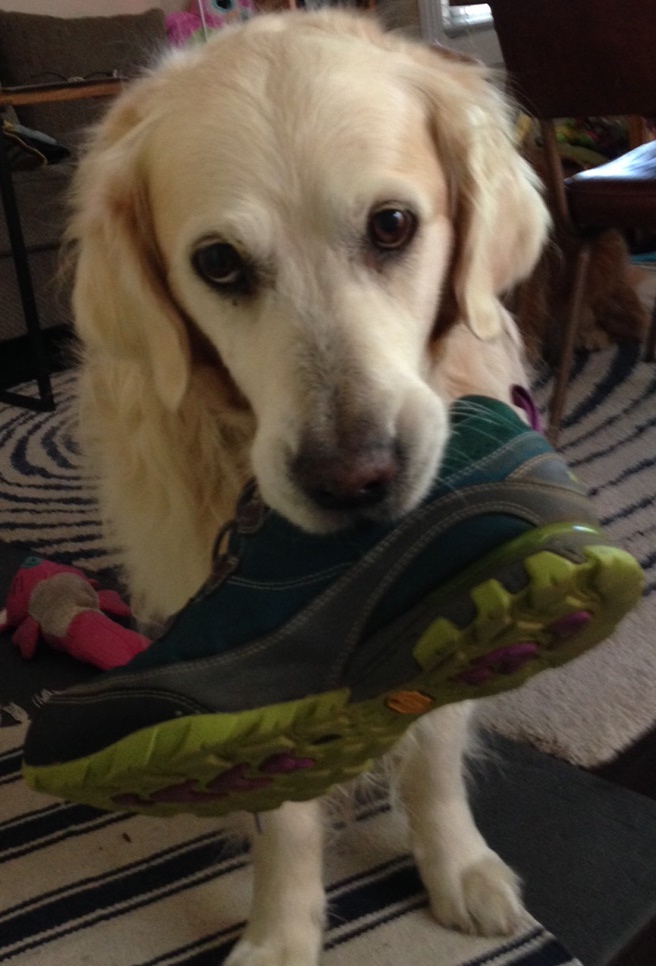
  • Many dogs will retrieve items that have not been requested in hopes of getting a reward. My dogs routinely bring me extra shoes in the morning, after they’ve been asked to bring my dog-walking shoes (and have been rewarded for doing so). This is probably optimism more than dishonesty, though. I routinely reward them for bringing me things that I have dropped, whether I was aware of dropping the item or not.

It gets even more sophisticated. For example, our German shepherd used to pretend not to know where the ball had landed when we threw it and he was busy sniffing something or chasing a squirrel. A request or two to get the ball would be completely ignored. Or, to humor the annoying humans, he’d search half-heartedly for a few seconds before doing the dog equivalent of shrugging and going back to something more interesting. “OK,” we’d say. “If we’ve lost the ball, it’s time to go home.” In under 10 seconds, he’d have found and delivered that “lost” ball.

Then there’s the golden who used the bells on the door to get Mom to open the door, knowing that her annoying puppy-sister would go charging out the door … while she stood there, smiling, as Mom closed the door with puppy outside and her inside.

So. While I will concede that not all of the above examples necessarily show deceptive behavior, some do, some might, and others at least indicate an ability to manipulate humans to obtain a desired end. I believe that dogs do lie and that they sometimes deceive each other and us. And they do it for a variety of reasons, including the possibility of getting a reward.

what the dog knowsI’ve been thinking about this since I read What the Dog Knows by Cat Warren. It’s a great book; I posted a short review here on the Thinking Dog Blog not long ago. It’s about scent-dog training, specifically, cadaver dogs. The author raises an interesting topic: False alerts. She’s brave to do this, partly because many dog people ran into what I think I am running into: Many people cling to decades-old and thoroughly debunked ideas about how limited dogs’ cognitive abilities are. But mostly she’s brave for another reason: Many handlers proclaim that their dogs are never wrong and become incensed if anyone suggests otherwise.

Some false alerts are the handler’s fault. Particularly when the handler is a beginner, and the team is at an early stage of training, the handler’s body language or other unintentional cuing might hint to the dog that “this is where” he should alert. In this case, the dog is not lying; he is trying to follow the cues he’s just learning, and thinks he’s doing what the handler wants.

Training and working in situations, like cadaver searches, where the handler is not always able to tell whether the alert is false further complicates the discussion. Some false alerts, as Warren explains, might not actually be false. She says that if they are training in a vehicle junkyard, for example, and her dog alerts on the seat of a smashed car with a shattered windshield, while that is not the target she’s searching for, she rewards the alert anyhow. The scents linger for a long time, and the dog probably did detect the scent of human decay (parts of the book do require a strong stomach!).

I’m not talking about those instances though. I wonder if — and at what stages of training — dogs intentionally, knowingly lie about detecting the target scent. There are certainly working situations where the handler might not know if the scent is present and therefore is likely to trust the dog and reward an alert. False alerts occasionally do cause problems in law enforcement.

She draws a distinction between false alerts that are outright lies and those that are more nuanced and, she says, even more insidious (though not always because of misbehavior from the dog). The dog is detecting something but is not entirely sure it’s the correct scent; or the dog has detected the scent but not found the precise location and alerts anyhow; whatever the case, in these instances, she explains, the dog isn’t consciously deciding to lie. As with human behavior, not all situations are easily explained, black or white.

Warren says she will never know whether her dog’s false alerts are inadvertent or are deliberate lies — but she does not rule out the possibility of a dog lying. She also says that her dog’s body language is so clear that she thinks she could tell if her were lying. Many humans betray their dishonesty through body language. Sometimes those “tells” are very subtle. A close study of our dogs’ body language might be our best chance at knowing when they are — and are not — trying to con us.

What do you think? Have you ever worked with a pathological doggy liar? An occasionally dishonest dog?


Secure in Her Dogness

Of our three girls, only Cali is truly secure and comfortable in her dogness. Alberta and Jana are quite sure that they are not dogs.

How do I know this?

  • Cali happily goes in and out the dog door, delighted with her independence and freedom to enjoy a large yard, from which she can survey the surrounding hills and valleys. Jana and Alberta go to the people door and bark. If their staff fails to appear in a timely fashion and let them in, they bark louder. They both will, if forced, use their keys to open the dog door and step disdainfully inside. But they really shouldn’t have to resort to that.
  • Cali is fine being left home, particularly if she can let herself out. She calmly accepts being banished to the porch with a visiting puppy to play. She’s perfectly content hanging out with other dogs, so long as she knows and likes these dogs. Alberta, rightly, assumes that Deni should take her along everywhere she goes. Jana just plain does not want to be left with the dogs. She does not want to be excluded from adult company, relegated to the puppies’ table (or porch), or treated like a dog. If left at a dog place — she has, on rare and very stressful occasions, been left at a groomer’s or a boarding facility — her facial expression, resistance, and loud protests all say: PLEASE don’t leave me with all these dogs!

I would say that Jana and Alberta are anomalies, shaped by our treatment of them to believe that they are somehow not quite dogs — but I have met so many other dogs who seem to be equally certain that they are not dogs. Molly, for example, whom I mentioned in a recent post. Of course, she’s a standard poodle, and I for one do not think that poodles are dogs. They are so close to being human. Molly clearly agrees.

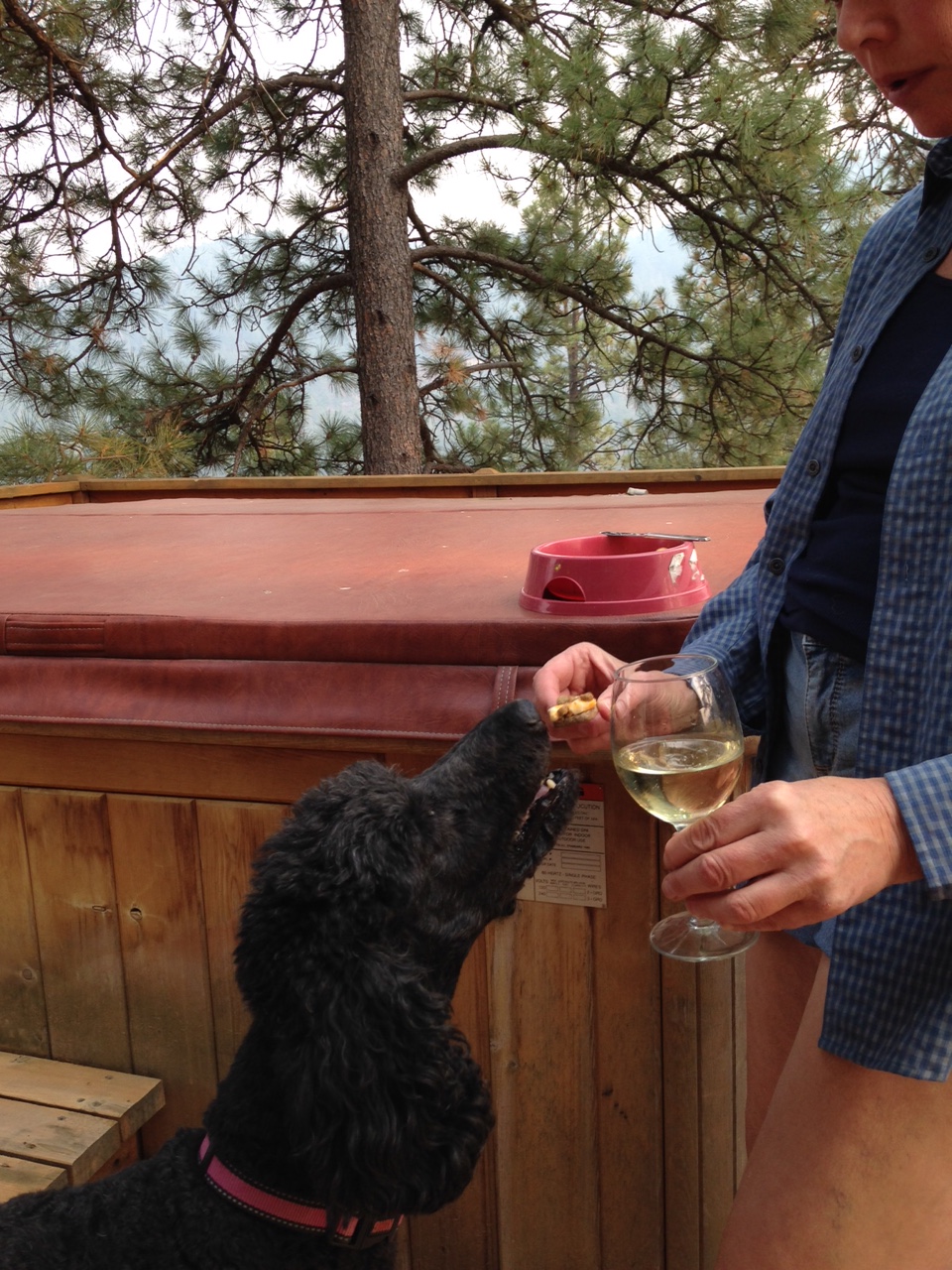
IMG_2095IMG_2090When Molly was visiting, she would not — could not — eat in the laundry room with the other dogs. Excuse me. With the dogs. She dined solo, al fresco, with a white-jacketed server in attendance. OK, so maybe Deni wasn’t wearing a white jacket, but the rest is true. Not only did she dine in solitary patio splendor, she had special meals. Chunks of cheese, biscuit crackers, slices of deli meat … the only way that Molly would eat kibble was on a cracker (biscuit) or in a turkey roll-up. She prefers white wine, not too dry and not bubbly. (OK, OK, she didn’t actually get any wine, either. But the rest is true. Really.)

But back to Cali. It is nice to have at least one dog who actually is comfortable being a dog and is happy to fulfill her role as the family dog. She’s very cuddly, for example, and loves to be petted. She’s always enthusiastic about going for a walk or out to play. She enjoys doggy things, like chasing after a tennis ball and refusing to bring it back, barking at deer, licking all the hand lotion off of my fingers, and begging for treats. She wants to be near me most of the time, even when I am doing boring (to her) things, like writing a blog post (she’s at my feet) or grading papers. Like her ancestor Oriel, Cali embodies everything people  love about dogs. She’s sweet, affectionate, playful and goofy sometimes. She’s great company and very friendly. And secure in her dogness.


Missing You?

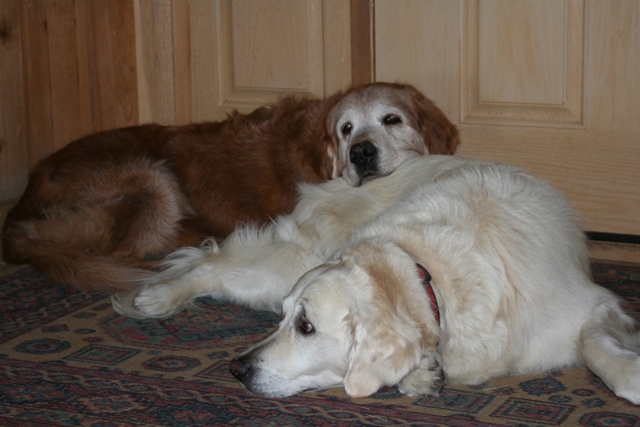
Does Jana still miss her best friend, Oriel?

Do dogs miss us when we’re away? Do they miss places they’ve been or items they’ve loved?

It’s clear that dogs remember people and places — and often, the landmarks or scents on the way to places that they either love or hate. Dogs can recognize a person whom they haven’t seen in years. Or a place that they haven’t visited in years: Oriel, our late and much-missed golden retriever once ran joyfully to the site of a small pond that had been dry for about a decade. The former pond was a short walk from her former home in Montana, and she hadn’t been there for at least 3 years. She became very excited as we approached the road to the house, too. And of course all of our dogs know the way to fun places and begin to show excitement ridiculously early in any journey in the general direction of the dog beach, Cali’s sister Dora’s house, the park where we play ball …

It’s also clear that dogs use these memories to anticipate, with pleasure or dread, future experiences. Dogs generalize and can become fearful of people or situations that remind them of unpleasant experiences in the past. A dog who fears going to the vet, for example, can recognize a vet’s office, any vet’s office, from several blocks away. Happy experiences have the same effect. Thus a dog who loves to run and play will decide that any open green space you happen to drive past would be a really fun place to stop and play ball. He might helpfully point out all the nice play opportunities say, between Northern California and Missoula, Montana, as you are driving. Believe me, there are hundreds of open green spaces in the American Northwest.

But do they miss us? Do they miss places?

This question becomes more relevant each day, as our departure from Montana gets closer and closer. Does Cali miss her play park and friends in Petaluma? More to the point: Will she miss her private play yard in Montana? Will she ever forgive me for taking her away from this idyllic place where she is so happy?

It’s also a question that many dog owners ponder if / when they leave their dogs with a dog sitter or boarding kennel when they travel. Does the dog pine for them? Wonder where they are? Or, as dogs do so well, does the dog simply live in the present moment, enjoying the attention of the dog sitter?

I’ve heard enough stories about how dogs behave after the death of a loved human or canine playmate or family member to believe that dogs grieve. Isn’t that an indication that dogs miss people or dogs who aren’t present?

I don’t have a definitive answer to any of these questions. I suspect that some individual dogs form closer ties to people, dogs, places, and other beings or objects and do, indeed, miss them. Other dogs appear to be — and may truly be — happy in the present moment, loving the ones they’re with.

So the answer might be similar to my answer to so many questions about dogs: It depends. Dogs are individuals. Your individual dog might miss you very much when you are gone. Or she might happily hang out with whomever is nearby. Cali might miss Montana. But Cali’s such a sunny optimist that I am betting she’ll be happy to be back in Petaluma and enjoy picking up our old routine and reconnecting with her playmates there.

At least, I hope that’s the case!