10 Years Young — Laser Treatments Reduce Jana’s Arthritis Pain

Jana enjoys Dog Swim Day in St. Petersburg, Fla.

Jana has just finished a course of cold laser therapy. With the zeal of the newly converted, I am here to sing the praises of this treatment for arthritis.

Let’s back up a little. Jana has had arthritic elbows and back and, unknown to me, hips, for a while. In the last several months, she has been noticeably more stiff and sore more often. She’s had regular chiropractic adjustments for years, and these have been very helpful. But it was no longer enough.

Very reluctant to put her on medication for the rest of her life, I started checking into other therapies. A vet in California mentioned cold laser therapy. It sounded promising; it is not invasive, has no side effects, and has helped many dogs with painful injuries or arthritis. But, I was about to drive back to Florida, so I decided to wait until we got back to Florida to start.

Fast forward to now. Our vet here in St. Petersburg does laser therapy in his office, so we scheduled some X-rays to see where Jana needed attention and took the plunge.

The X-rays showed a lot more damage than I expected and explained Jana’s morning stiffness, reluctance to walk or play, and general grumpiness of late. That was about 3 weeks ago. Six laser sessions later, Jana is actively soliciting play, swimming, and catching balls, and she is happier than she has been in months. She’s less stiff and more cuddly. She is clearly in less pain.

Each treatment takes about a half-hour. The vet tech programs the machine for hip, elbow or back, and waves the wand over the targeted body part. Jana got lasered in both elbows, both hips, and much of her spine. The vet techs have treated wounds, post-surgical sutures, muscle sprains, and a variety of other ailments with the cold lasers.

The laser stimulates blood flow, which helps injured tissue to heal. The idea is that it will improve blood flow around the arthritic joints, reducing inflammation and therefore reducing pain. It seems to be working on Jana.

I am giving her small amounts of Rimadyl, as well as other anti-inflammatory supplements, but I am hoping to be able to reduce the pharmaceuticals further. She’ll now go to a maintenance schedule of treatments about once a month. I am sure that each dog reacts differently to treatments, but I have to say this one is worth trying if your senior dog is stiff or painful.

Food Before Thought

IMG_1725

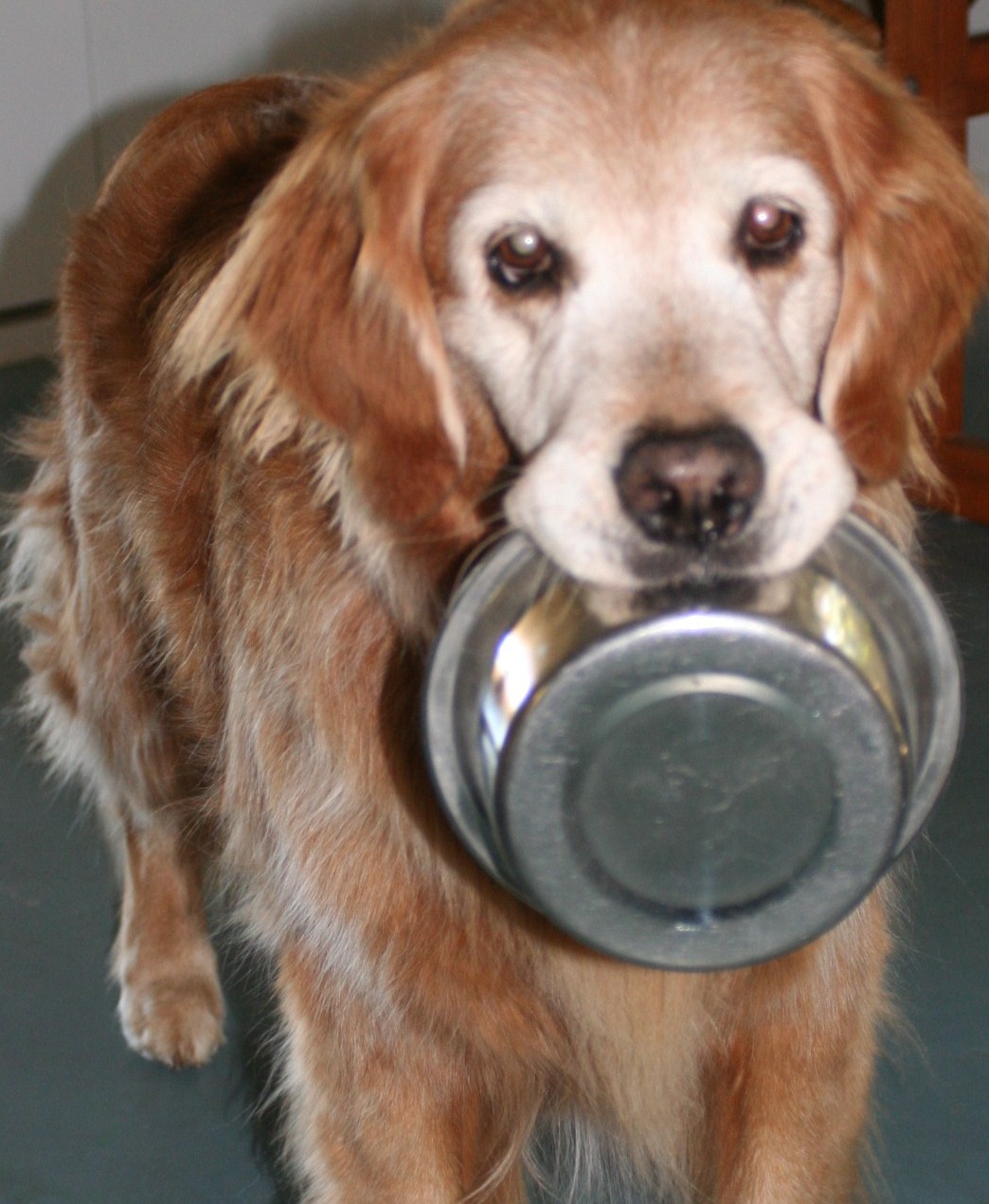
As Deni and Albee prepared to head off to a Rally Obedience class the other night, we discussed when to feed the dogs their dinner. Many trainers over the years have advised their human students not to feed dogs before training class. The dogs work better when they are hungry, is the claim. Deni and I pondered this, wondering whether it was good advice, anthropomorphism gone amok, or just plain silliness.

If it is an attempt to look at dogs through human eyes (the anthropomorphism gone amok theory), I guess it can be argued that really wanting something might make a being focus harder on what he or she has to do to get it. Therefore, if the dog really, really wants food, wouldn’t the dog focus harder on figuring out how to get it? Might sound plausible … except for a few problems. One is that the tiny tidbits of food a dog gets as rewards in training hardly take the place of a meal. And, this theory demands that you ignore stacks and stacks of research about learning or concentration and hunger.

Kids do not learn well when they are hungry. A really hungry child, and, probably, a really hungry dog, simply does not focus well. Research showing this has led public schools in low-income areas to offer not only free lunches, but breakfast as well, in attempts to boost concentration and improve kids’ learning.

Adults’ performance also suffers if we don’t eat a healthful breakfast. We know this, yet somehow think that our dogs will focus and learn if they are hungry? Doubtful.

Some trainers make a comparison with human athletes and point out that athletes are unlikely to eat a large meal just before a workout. Sure, but if training class is at 7 p.m., that is not a valid argument against feeding the dog at 5. Anyhow, a Rally class, an obedience class, even an agility class has a lot more in common with a grade-school classroom or a desk job than a triathalon. The dogs are not asked to perform athletic feats for hours, or even minutes on end. They are asked to pay attention to their handlers, to ignore distractions, to figure out what is needed, whether it is touching the contact at the end of the dog walk, sitting and staying for three minutes, or walking on a loose leash. The demands are primarily mental.

But there’s another, more important element. When trainers talk about training, it’s hard to avoid mention of the four quadrants of operant conditioning / behaviorism. The positive reinforcement quadrant is the one we are most familiar with — rewarding behavior we like. Ostensibly, the advice to train hungry dogs ties in with this: The dogs will get food rewards for their performance, and better performance will lead to more rewards. It’s all good, right?

Let’s look at it more honestly. Depriving a being of something it needs in order to get it to do what you want is called … torture. Withholding meals, then providing minute rewards for compliance falls into the “negative reinforcement” quadrant — removing a negative when the dog performs the requested behavior is supposed to increase the likelihood of the dog performing the behavior. Late dinner is about as negative as it gets for some dogs!

I know that comparing delaying a meal with common negative reinforcement techniques like ear pinch is an exaggeration. But comparing dog training class to an athletic workout isn’t? The dog will (eventually) get a meal, so feeding after training is not really abusive. But it is unfair. And it exploits the complete control we humans have over every aspect of our dogs’ lives.

The advice to delay meals might have been conceived by trainers who worked with dogs that are less food-obsessed than golden and Labrador retrievers. I still think it is wrong. A meal and tiny little training rewards are not the same thing. If your dog is unwilling to work for the training rewards you are offering, it is not because you have fed him; it is because the rewards you are offering are not, in that dog’s mind, motivators.

The cardinal rule of any kind of motivational training is that the trainee — the dog — determines what a motivator is and therefore what the reward should be.

If your training treats only motivate your dog when he is ravenous, skipping dinner is not the answer. Try using better treats. Try using a tennis ball, a tug toy — anything that your dog loves — as a reward. I might be willing to work for several hours to earn a paycheck that will arrive next week, but Cali, Jana, and Albee will always choose the freeze-dried liver over the cash — and they want it now, please. In fact, they will choose liver over and over again, at every opportunity, regardless of whether they’ve had dinner.

Service Dog Appreciation Week!

service dog week

As National Service Dog Appreciation Week draws to a close, I want to draw your attention to an article I co-authored with Deni Elliott. It is a discussion of the current and growing problem of fake service dogs and “inappropriate” service dogs, that is, dogs who may be trained to assist a person with a disability but who are not trained for public access and/or have a temperament that makes them unsafe in public spaces. Unfortunately, Deni and other service dog partners are encountering more and more dog-reactive dogs, which makes it challenging and unsafe for their dogs to work.

Our proposal, which might be controversial, suggests a solution. We hope this article will be part of a larger debate in the service dog community as well as among policy makers and will ultimately help find a solution. You may download the article from Deni’s website or from the portfolio page of this website.

Big Girls Just Wanna Look Cute

Cali, at 8 months old, is dashing full speed ahead into adolescence. Having read the latest studies and talked to her breeder, I know that it is better for her health to wait to spay her until she is done growing — in about another year. That means that she will have a “season” (or three).

Before all the spay and neuter people howl, let me say this: I do not think that having an intact dog of either sex is easy or desirable. I agree that most pets should be spayed or neutered. I also want what is best for my dog, and I know that I can ensure that Cali is safe and does not inadvertently become a teen mom.

Back to Cali’s impending womanhood. We’ve had the talk about birds, bees, and handsome boy dogs. And I went online to search for some britches for my soon-to-be bitch in heat. That’s not the only reason a furry girl (or guy) might need to go shopping. Dogs need clothing for different reasons. As dogs age, some (like some humans) become a bit leaky. Then there are the ones who lose control when they get excited.

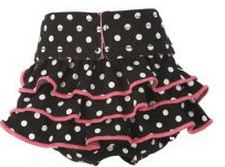
dotted skirtWhatever the reason, there are dozens and dozens of fashion options out there. Anything from princess skirts to rhinestone jeans to cargo pants. Camouflage and spangles. Cotton candy pink to red plaid flannel. Miniskirts, shorts, and overalls with little criss-cross straps — even thongs —  for the girls. Overalls, jeans, jock straps and cummerbunds for the boys. Unisex tracksuits, girlie ball gowns, Hawaiian-style board shorts, you name it.

If your dog fits into a purse, that is.

Unwilling to give up after a short search turned up … nothing, I kept digging. I optimistically clicked to a link for X-large Petego Hot Pants. They come in black or hot pink and feature a small ruffle bow. Sounded good (in conservative black, maybe), but … an extra-large measures 16 inches at the waist. Sixteen inches! Cali was 16 inches around the waist when she was 3 months old. Waaay before puberty.

Cargo pants for dogsShe’d look great in a pair of cargo pants, which were offered in sizes 00 to 6. Sounded promising. But a size 6 fits dogs only up to 25 lbs. That mark on the scale is in Cali’s very distant past. (The 00 is for dogs who weigh under 2 pounds. Are there really adult dogs that small?)

Maybe a ruffled miniskirt with polka dots would do? Adorable, age-appropriate, and available in extra-small to extra-large. But wait. The extra-large fits dogs up to 22 lbs. In what universe is a 22-pound dog “extra-large”?!

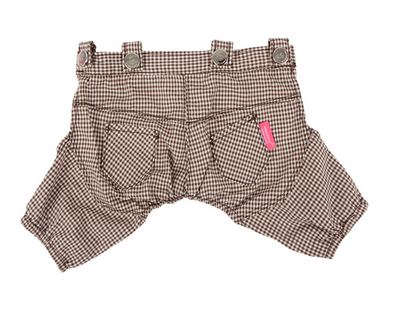
Checkered pantsCali could have ordered the urban ski pants for dogs from Baxterboo (up to a 26-inch waist) but they seemed a bit warm for a Florida summer. The cute checkered pants, in brown or pink, however, only go up to a waist of 11 inches. Baxterboo did have lavender bell bottoms in Cali’s size (on sale)! But Cali’s not really the hippy chick type. She wants to fit in with Florida’s sundress-and-flip-flops vibe.

Finally, I found what Cali needed at two retailers on Etsy.com. Thank goodness for creative, entrepreneurial people. Both Etsy retailers will customize for size and fabric, so dogs of all sizes, shapes, and tastes can dress stylishly during their time of the month.

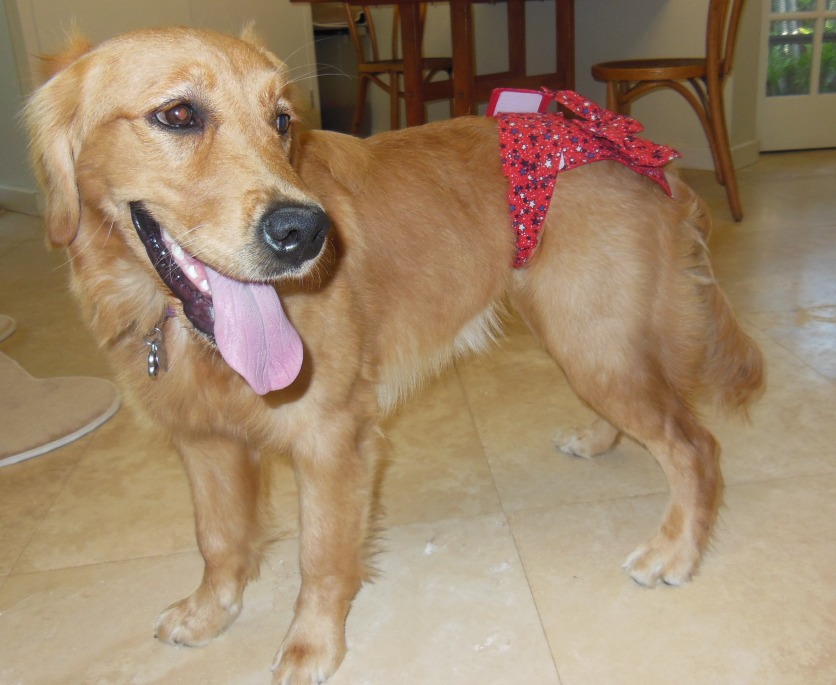
cali_red stars_cropThe first retailer, CodysHaven, proclaims that “Larger breed girls need to look good too.” Darn right they do. CodysHaven sent us a red, star-spangled pair of shorts for Cali that are adorable. There are dozens of fabrics to choose from, in case stars aren’t your style.

Cali’s second, dressier outfit is from The Purple Puppy. It is more of a miniskirt, with big, colorful daisies and a white ruffle.

Flowers and stars. Cali is, after all, still a little girl. Maybe it’s better that the hot pants didn’t come in her size.

Cali flowered skirt_crop