Dog Days of Summer

Most of the country has experienced record heat this summer. A common response among dog owners is to get the dog shaved, thinking the dog will be cooler. Is giving your dog a buzz cut really the best choice? How can you help your dog cope with the heat?

Regular grooming, especially for non-shedding breeds such as poodles, is a good idea for any dog. However, a close shave is not recommended. Some dogs dislike short haircuts, even going into hiding after a too-close shave. But your dog’s self-image isn’t the only concern when going for extreme summer grooming. The dog’s coat provides protection against sun and heat — and against sunburn.

Regular bathing with a moisturizing shampoo and frequent brushing to remove mats, debris, and loose fur will keep your dog’s coat clean and beautiful. A shampoo with aloe and oatmeal is a good choice in hot or dry weather or for itchy dogs. A trim might be in order for long-haired or thick-coated dogs, but many groomers advise clipping the top coat and leaving the undercoat for protection. The fur provides natural protection from the sun. Dogs can not only get sunburned, they can get melanomas, just like we humans can.

Canine melanoma usually appears in dogs’ mouths and on their skin and toes — areas that might be exposed to the sun. Skin melanomas occur more on dogs with dark skin, and they look like large, flat, wrinkled masses or small, dark lumps. These tend not to spread or be malignant.

However, melanomas occurring in the mouth, behind the eyes, or on dogs’ toes can be malignant. Despite the similarity in name, these melanomas are not connected with sun exposure and are thought to have a genetic link. Early signs of an oral melanoma include bad breath, bleeding around the mouth, coughing, excessive drooling, trouble swallowing, and excessive weight loss.

Other forms of skin cancer, such as squamous cell carcinomas, are often caused by sun exposure. These can be aggressive cancers. Short-haired (or shaved) dogs are at greater risk for squamous cell carcinomas, and they often occur on the feet, abdomen, and around the genitals — areas with thin or no hair. Squamous cell tumors look like warts and are firm and raised from the skin surface.

Finally, mast cell tumors, the most common form of canine skin cancer, are usually slow-growing but can also be aggressive and can cause inflamed ulcers on the dog’s body. These might be genetically linked, but they have also been linked to irritants or inflammation of the skin.

Monitor your dog carefully — daily brushing and petting will help you notice changes in skin color or texture. Have a veterinarian check any growth or tumor immediately. Many skin cancers can be treated successfully if caught early.

But skin cancer is not the only heat-related summer problem.

Dogs can overheat and even get sunstroke from spending too much time in the summer sun — or in a hot car. On a warm day, never leave a dog inside a closed car! Even with windows open, the interior of the car heats up fast and is much hotter than even the outdoor temperature. Sunlight streaming through the glass windows is turned into heat. Too many pets die each summer because their owners left them in the car “just for a minute.” Don’t risk it.
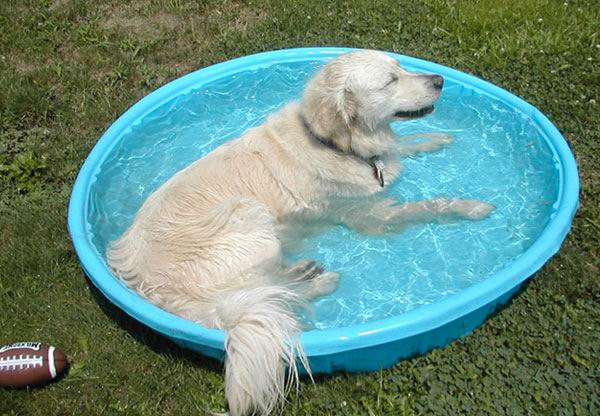
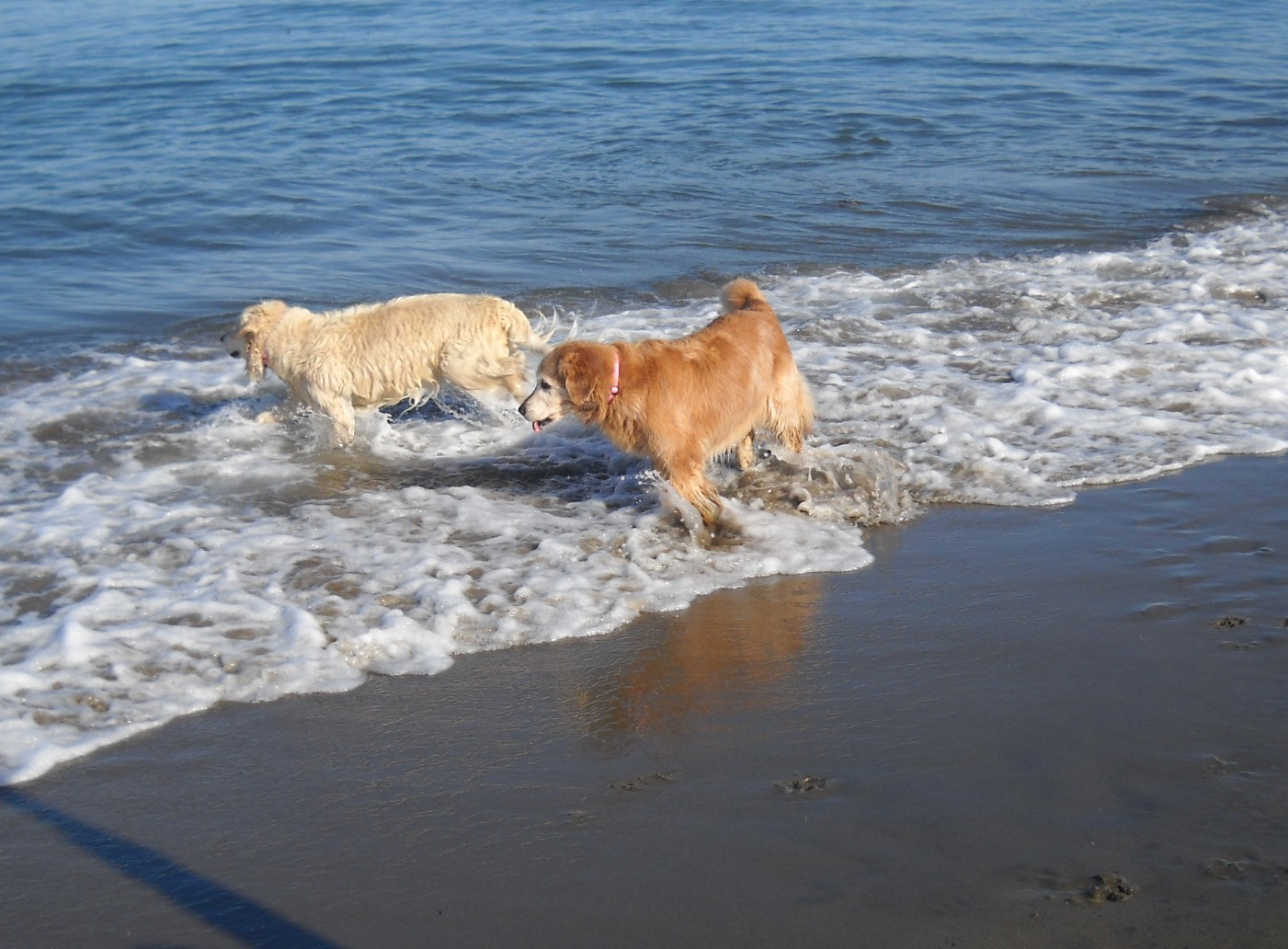
It is possible to enjoy outdoor play with your dog in the summer, though. Dark-haired dogs can wear white T-shirts to stay cooler (wet the shirt to keep the dog even cooler). Or let your dog wear a cold, wet bandanna or neck wrap to cool off. Other dogs take matters into their own paws, finding a pool or puddle to lie down in. If there’s a dog-friendly beach nearby, spend a day at the dog beach.

Enjoy the summer — but make sure that your dogs have shade when outdoors, can come indoors in hot weather, and always have access to fresh water.
What is your opinion of an E-collar?

I got this question from a friend who is dog-mommy to two wonderful, if highly energetic, girls.

My short answer was that in general, I believe that they are used too often by people who want a “quick solution,” and they are not used correctly — and that therefore they end up being used in a way that is unfair and abusive to the dog. I abhor punitive training and think that in nearly all cases it is not only unnecessary but counter-productive.

But.

I also hesitate to completely rule out the use of an e-collar (an electric shock collar). There are a very, very few cases where the use of an e-collar, with a skilled, ethical, experienced trainer, might be justified. Continue reading

Wily Wylie

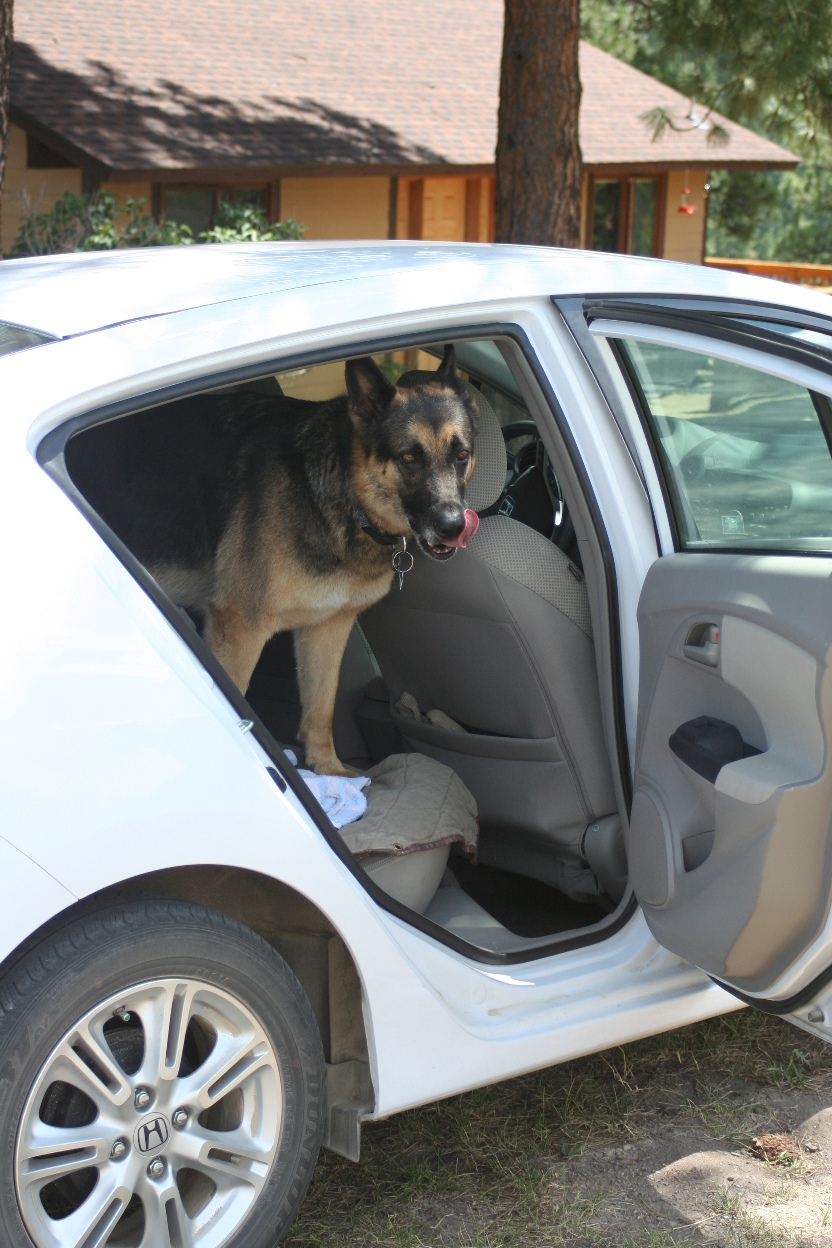
The chipmunk was driving Wylie crazy while Deni put the car’s backseats down in preparation for transporting some boxes. Taunting him, chattering nonstop, and darting around the yard. It ran under the car. Wylie ran around and around the car, fixated on the annoying rodent. Deni stepped around the dog, adjusting the seats through the car’s open doors. The crafty chipmunk stayed under the car, just out of paw’s reach. Then Wylie had an idea. Jumping into the backseat of the car, Wylie paced, peering intently out each door. He had figured out that, if that darned racing-striped rat didn’t see him, it would feel safe enough to leave the shelter of the car — and Wylie would be ready when it did!

Wylie’s idea of outsmarting the chipmunk (foiled only when Deni called Wylie back to the house and closed the car doors) shows his ability to strategize. Wylie uses his canine wiliness and planning skills in other ways as well. He’s not the only one.

Anyone who lives in multi-dog families has surely seen a gambit popular with Jana, Wylie’s doggy sister. Noticing that Wylie has a bed, bone, or toy that she might like, she suddenly looks intently out the sliding glass door or runs to the dog door, madly barking her “Look! What’s that in our yard?!” bark. Ever the dutiful watchdog, Wylie immediately goes to investigate and use his authoritarian German Shepherd voice to scare off any dangerous intruder. While Wylie’s scanning the horizon, hackles raised, Jana saunters over to the bed, bone, or toy he had been enjoying … and takes possession.

These stories and many more indicate that dogs have what is called “theory of mind.” Theory of mind means that they are aware of points of view other than their own and use that awareness to guess what another creature might do in a particular situation. It’s a necessary element for empathy and plays a role in much higher-level thought and social interaction.

For many scientists, though, theory of mind is a crucial component of what makes humans, well, human — and unique. As in, smarter-more sophisticated-better than non-human animals. Human children begin to demonstrate theory of mind by about age four. So attributing theory of mind to dogs can be controversial. Some psychologists and dog researchers who are reluctant to attribute theory of mind to dogs ascribe dogs’ ability to “read” us humans to group consciousness or instinct.

Increasingly, though, some are willing to at least take a tentative step out on that limb.

Psychologist and dog cognition researcher Alexandra Horowitz, for example, proposes what she calls a “rudimentary theory of mind” that might exist in dogs. She defines this as “more than acting instinctively, or as a behaviorist, but less than acting with the theoretical understanding characteristic of humans.”

I’ll take that; I am not (yet) ready to argue that dogs’ cognitive abilities are on a par with those of the average human. But there are too many examples of dogs anticipating and manipulating others’ behavior and empathizing with others’ emotions to ignore the evidence that suggests that dogs show theory of mind. And it is important to consider that we, with our human limitations, are measuring dogs’ theory of mind based on how it works for humans. It’s a good bet that we haven’t come up with a relevant-to-dogs way of testing it yet.

It’s cool enough that dogs show theory of mind about their own species, even if they tend to use it, as Jana does, for nefarious purposes. But it’s even more amazing that dogs use theory of mind in their interactions with humans, often anticipating what we’ll do — and coming up with endless ways of manipulating us to walk, play with, and feed them. Any dog who has ever brought his or her human a leash, an empty bowl, or a ball is showing theory of mind (as well as creative communications skills and great optimism!). Wylie was even using theory of mind to try to imagine how the chipmunk might change its behavior if the dog was out of sight. Better luck next time, Wylie!

Jana Rocks

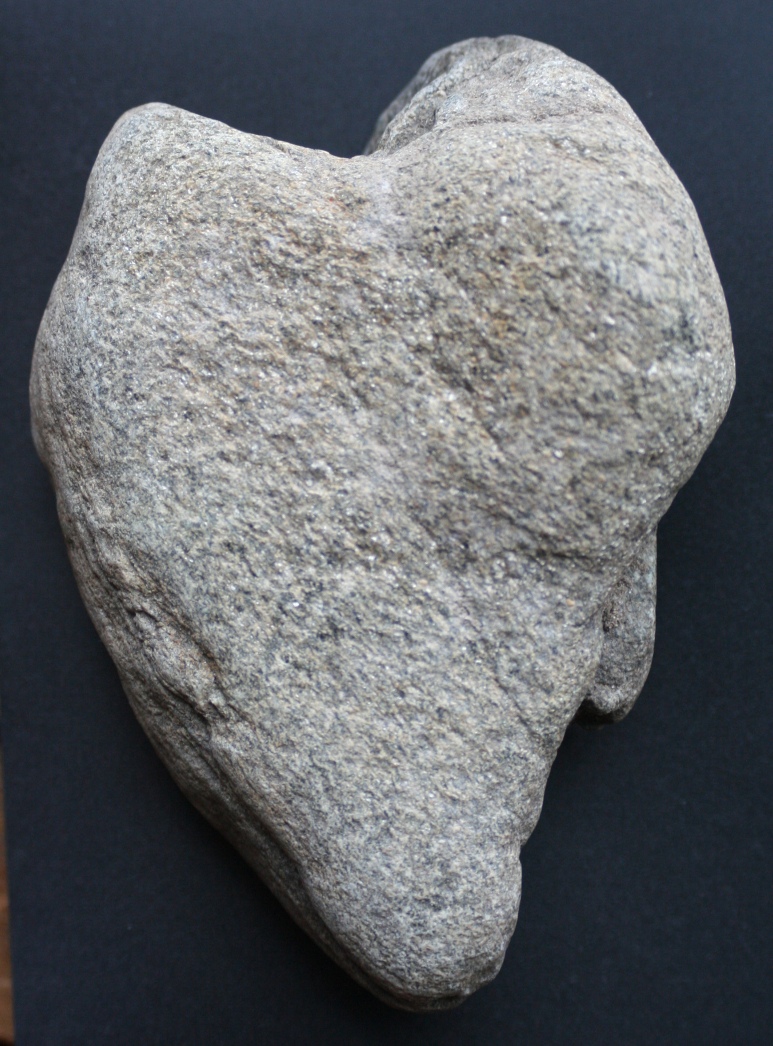
What’s the best present your dog ever brought you? Mine is the rock pictured here. Jana pulled it out of Lolo Creek at Fort Fizzle, one of our favorite spots to spend a hot summer afternoon. It joins this one:

Jana pulled it out of the same swimming hole last summer.

Does Jana know that hearts have a special meaning to humans? Do dogs use symbols to communicate the way humans do?

Those questions are not as farfetched as they might sound.

Jana loves hunting for rocks in the water, and she often pulls them out to collect onshore or to hand to me for safekeeping. She’s pretty selective about the ones she picks up.

She pokes her head under water, holding her breath as she looks for the perfect rock. Once she’s selected a rock, she lifts her head out and works the rock loose with her paws, then puts her head under water and grabs it. Some of them are huge for a 60-pound dog to carry, weighing a two  pounds or more. Sometimes, I throw one back. And she pulls it out again, often giving me a disgusted look in the process.

They are not all heart-shaped, of course. This stretch of river offers her a large selection of rocks in many sizes, shapes, and weights. Yet many of the rocks Jana chooses are triangular or have an elongated shape and rounded corners.

I can’t help wondering why Jana seems to prefer heart-shaped rocks. Is she sending an intentional message?

Dogs, like humans, regularly  use symbols to communicate with their human and canine friends. Many dogs, for example, bring a leash or guide their human to where the leash hangs to ask for a walk. A human donning a certain pair of shoes can trigger a wild dance of delight in other dogs. Play, aggression, and calming signals are part of universal canine-to-canine body language.

Dogs quickly learn to associate specific actions, such as sitting, coming, or lying down with humans’ spoken words, hand signals — and even printed words or pictures.

But dogs’ abilities go far beyond understanding simple concepts and associations. Studies in canine cognition labs around the world constantly expand our knowledge of how dogs understand high-level concepts.

Dogs have shown that they recognize people in photos and can differentiate between photos of dogs and other creatures. They even associate the sound of a growl with a photo of an  appropriate-sized dog who might make such a sound, looking at a photo of a large dog upon hearing a deep, big-dog growl, for example.

Dogs also learn to associate pictures with concepts. I’ve taught dogs to respond to flashcards printed with words or stick figure dogs showing specific behaviors  (sit, down, speak, etc.). And a researcher in Florida, Dr. Lauren Highfill, recently did a study where dogs learned to ask for their preferred reward by choosing the corresponding picture. They first learned to associate a food reward with one picture, a toy with another, etc. Dr. Highfill even had a “surprise” reward category that allowed dogs to ask for an unknown reward. Some dogs consistently chose to be surprised, while others always asked for their favorite.

So, back to the heart-shaped rocks. I haven’t intentionally taught Jana any specific association with hearts, but she has seen me collecting (much smaller) heart-shaped rocks on our walks together on many different beaches. Maybe she just knows that the symbol is, for whatever reason, meaningful to me.

Jana is very bright and perceptive. Even so, it’s a bit of a stretch to think that she has somehow picked up on the idea that, in human culture, the heart shape stands for an expression of love. It’s not as much of a stretch to think that a watchful dog knows what pleases her human partner and enjoys finding ways to do that. Whatever her reasons, the heart-shaped rocks are gifts from Jana that I will always treasure.