We ALL Make Mistakes

We humans have an uncanny ability to notice what we don’t like. Just look at all the nasty comments posted online, or listen to people’s conversations. Sometimes, it seems that all we ever do is complain about the dumb things other people did or said. We jump on people for every mistake they make. We do it to our dogs, too. We always notice when they are barking at the deer in the yard or they jump onto the sofa, uninvited. We yell, criticize, complain, even punish.
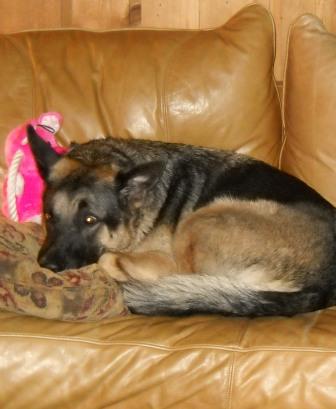
Busted!

Old-school training methods emphasize punishment. Rub your puppy’s nose in it if he pees in the house. Smack your dog with a rolled-up newspaper. Put him in a crate for a time-out if he is mouthy. Knee him in the chest for jumping up to greet you. Shock him for barking or for crossing some invisible line that is supposed to separate “his” territory from the rest of the world.

As I wrote in Reward or Punishment?, we all can learn from negative consequences that a particular behavior was not a good choice. Yes, a dog can learn what not to do through punitive “training” methods. But that information doesn’t often help him figure out what would be a better or the correct choice of action. There might be a lot of other options, and most of them might be equally wrong. Punishing a dog who hasn’t been taught what the right behavior is, is unfair. And, even when we know what is wanted of us, we all make mistakes.

Instead of jumping on every mistake, positive training focuses on eliciting or teaching behaviors that we want the dog to engage in — and rewarding them.

Some people use targeting or a lure to elicit a behavior. This could be as simple as patting your leg to encourage a puppy to come to you or having the dog follow a treat held above his nose to get him to sit or lie down.

Some use shaping, which is waiting for the dog to do something that might barely resemble the behavior you want, and rewarding that, then slowly raising the bar until you get the desired behavior. An example is teaching your dog to turn left. You might first reward a tiny glance to the left. Then a longer glance. A slight head turn. A half-turn of the head. A full head turn. Etc. Until the dog turns left.

What is most important about these teaching techniques is that if the dog guesses wrong, turning his head to the right, say, rather than the left, or backing up instead of sitting — you don’t do anything. No scolding or yelling, no “correction” or punishment. You simply change position and try again.

If the worst consequence to getting it wrong is that the puppy doesn’t get the treat — but he immediately gets to try again, making mistakes is safe. He’ll soon learn that trying different ways to do something until he gets it right is not only safe but it’s fun. That will make him more likely to guess again than if the consequence of an incorrect guess is painful or unpleasant. He’ll also be more willing to try new things — which teaches him to think and problem solve. Don’t you want a thinking dog?
Reward or Punishment?

A response to a previous post accused me of being “painfully obvious in your contempt for any form of training outside of rewards or ( +R ) only” and ill-informed and biased to boot. I feel compelled to respond.

Anyone who thinks that any training (or life) can be wholly positive is wholly mistaken. Life delivers consequences, sometimes for actions taken intentionally and sometimes simply by chance. Some of the consequences are pleasant, some are not. There is no way to ensure that my life, my dog’s life, or the life of any dog I am training will be aversive-free. And, I believe that we all learn from the consequences of our actions, whether those consequences are pleasant or not. So, yes, I do believe that we, and our dogs, can learn from aversives. If we get burned, we are more careful around a hot stove. That said, I believe that, as a teaching tool, using aversives is unnecessary and cruel — and a lot less effective than other methods.

Behaviorism identifies four “paths” of learning through consequences, or four types of behavior-consequence pairs. What my critic referred to as “+R” is positive reinforcement, rewarding a behavior in hopes of encouraging the dog (or person or goldfish …) to repeat it. This is the foundation of motivational training. But some of the other three behavior-consequence pairs are useful too. Few trainers use only one; I would go so far as to argue that it is impossible.

What are the other three?

Next up is negative reinforcement.

Since this is often confused with another type, negative punishment, I’ll offer an easy way to sort out the four types. Dr. Pamela Reid, an outstanding trainer and behaviorist, and one of my teachers, explains it this way: “Positive” means you add something; “negative” means you take something away. “Reinforcement” makes a behavior more likely to be repeated; “punishment” makes it less likely.

Thus negative reinforcement (like positive reinforcement) is likely to cause the dog to offer a behavior again, but instead of giving the dog a reward (positive reinforcement), you are taking away something that the dog doesn’t like. Our dogs use this on us all the time; they get us to play with or feed them by bugging us until we do. By performing the desired behavior (feeding) we end the negative (heads jostling our hands when we’re trying to type and sad-eyed faces resting in our laps).

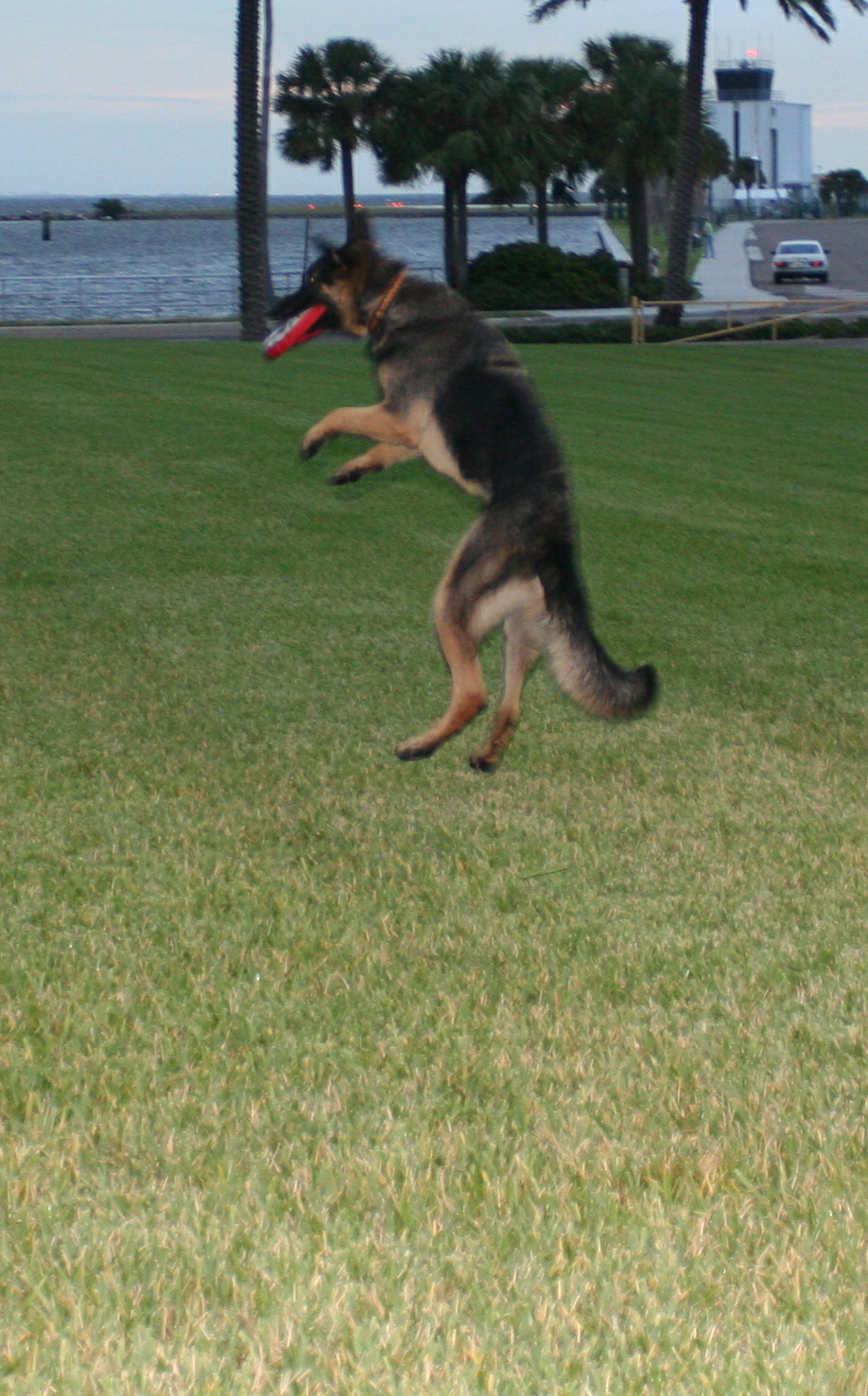
So what is negative punishment? Well, it’s punishment, so it makes a behavior less likely to recur. And it’s negative, so it means taking something away. Here’s an example: when our shepherd gets mouthy and rough during play with a ball or Frisbee, I warn him once not to touch me. The next time his mouth touches my hand, the game ends. Ending play early is a punishment to him; I am taking away something he wants. It does make the mouthy behavior less likely to recur; he is always more careful the next several times we play.

The fourth pair is positive punishment. This is adding something that will make behavior less likely to be repeated. Kneeing a dog in the chest for jumping up on you is a common example. This is the one pair I try hard not to use in teaching or training.

I have studied learning theory and behaviorism, and I have applied this knowledge in training hundreds of puppies. I have also studied the effects of punishment. Based on both my research and my experience, I firmly believe that the best way to teach new skills or encourage desired behaviors is through motivation and reinforcing those behaviors. But this is not always practical, and, in some situations, negative punishment can also be useful.

I also believe that anyone who chooses to use positive punishment must think carefully about the consequences and the alternatives. There might be situations in dog training where it is justified, but these are few and only, I think, when a dog’s or a person’s life or safety is in jeopardy. I cannot justify the routine use of positive punishment as a part of my training toolkit.

Motivating and encouraging a dog to do something tells the dog what you want — and rewards him when he gets it right. This is knowledge he can apply in the future and generalize to learning new behaviors and skills. Simply punishing him for getting it wrong tells him what not to do — but for every one behavior we are looking for, there might be hundreds of wrong guesses. Punishing each wrong guess is not going to give the dog information that steers him toward the right answer, but it might shut him down and discourage him from trying.

Kneeing your dog in the chest for jumping up in greeting, the example given above, can be harmful to the dog. It almost certainly harms your relationship with your dog. It might teach the dog not to jump on you in greeting. What it does not do is teach him how you want him to greet you. He might try barking wildly as his next guess. Not an improvement.

Your dog jumps because it is a normal doggy way to greet, because he’s happy to see you, because he wants attention. But, since you are the human and, at least in theory, you are in charge, you can decide that you’d rather he bring you a toy or sit next to you or walk around you in a circle when you get home. You can use positive reinforcement to teach the dog to do that, rewarding him, let’s say, with treats and attention each time he sits quietly to greet you. You can add in some negative punishment by ignoring him when he jumps. Soon enough, the dog will learn that to get your attention, he needs to sit next to you, not jump. You’ve not only reduced or eliminated the bad behavior, you’ve replaced it with a good one, all without hurting your dog. In the process, you have probably had fun with your dog, and you have improved communication with him and probably strengthened your bond as well — not a bad return on your investment of a little of your time and a handful of dog biscuits.

Peanut Butter and Invisible Fences

We’d been congratulating ourselves all summer on the absence of rodent roommates in our Montana residence when, on their first night here, our visiting friends spotted a mouse. Out came the mouse traps, baited with peanut butter. Out came the baby gates, keeping the dogs away from the traps.

A couple of mornings later, forgetting that there were still traps out, I let Jana come downstairs with me. Zeroing in on the scent of peanut butter, Jana beelined for its source. SNAP!

Jana’s head jerked back, then her nose immediately moved forward again, seeking and finding the now disarmed peanut butter. Once she’d licked the snapped trap clean, she hunted for others. A week later, she was still checking that area of the office for traps, uh, peanut butter, every morning.

I will do anything for food

Though I have no doubt that her reaction would have been different if the snapping trap had actually nipped her nose (she might have taken a full minute to recover before going for the peanut butter) the experience reminded me of why I so strongly dislike invisible fences:

If a dog’s motivation to go after something is strong enough, a moment of shock or pain will not deter her.

The thorough training that is supposed to — but rarely does — accompany the installation of invisible fencing should, it is claimed, teach the dog to avoid the “fence” so as to avoid receiving an electric shock. The dog is fitted with a collar that normally gives a warning beep if the dog approaches the underground wire that makes up the “fence.” The collar is supposed to deliver a shock only if the dog ignores the warning. Leaving aside the issues of malfunctioning fences and collars, this system rarely works as perfectly as the salespeople describe.

For some dogs, the experience of the shock, felt during “training” is enough to deter the dog from ever again approaching the perimeter of the yard. (For some dogs its enough to deter them from going outside at all, and it can have even worse effects, too, but that’s another blog.) But dogs who are that easily deterred are rational enough to be taught to stay in the yard without shocking them. For many other dogs, the shock wouldn’t work.

For instance, take a dog like Jana, who is highly motivated by food. A moment of pain isn’t much of a deterrence. She’d cross an invisible fence in a heartbeat if someone on the other side proffered a spoonful of peanut butter.

A more likely scenario arises with dogs like Wylie, dogs who love to run and chase things. These dogs would be unlikely to consider — or even notice — the shock as they flew across the yard and over the boundary, in hot pursuit of a running cat, deer, or other fleeing animal. This dog might, however, think twice about coming back into the yard on his return home after the chase. Winded, walking more slowly, he’d approach the “fence,” hear the warning beep, and, quite likely, decide that going home wasn’t worth the pain.

An additional problem with invisible fences is, of course, that anything at all — the mean dog from down the street, a cat, a coyote — can get into the yard and harass or harm the resident dog, who cannot run away without being “punished.”

So. An invisible fence doesn’t keep your dog safe and won’t contain the sort of dog who most needs strong boundaries. The only thing that can do that is a lot of (humane) training and a watchful human on the premises.

If you’re wondering what happened to the mouse, he (she?) was electrocuted while chewing through the wires to a bathroom light fixture, shorting out the light in the process. No rodent friends or relatives have been spotted, and the light has been replaced.

Oriel Finds Her Voice

This slideshow requires JavaScript.

I’d known Oriel for a few years before she came to live with us. She’s a sweet, affectionate dog and I always noticed that — in marked contrast to Jana — she is quiet. In fact, she reportedly barked fewer than a dozen times in her entire working life, and when she did, it was a single, surprised WOOF?

I also noticed that Oriel has the most active dream life of any dog I have ever known, complete with legs twitching and frequent vocalizations. But when she was awake, Ori was pretty much silent.

Then one day, my friend, who is severely allergic to dogs, was visiting. Ori, who frequently solicits petting by approaching people and putting her head under their hands to get the action started, was placed in the office — a large, spacious room, complete with comfy dog bed, water bowl, and access to the outdoors. Jana, since she is a bit aloof and rarely goes up to people and touches them, was allowed to stay with us as we talked in the kitchen.

Suddenly, I heard a sound that was almost like a baby crying. It was heartbreaking. It was Oriel, crying her little heart out over being banished. (We let her join us.) Not long after that first incident, we had several guests and, again, the dogs were behind a closed door. Soon, an unfamiliar, gruff bark sounded. I’ve heard Jana and Wylie bark often enough to recognize any of the myriad variations of their barks. It wasn’t Jana. It wasn’t Wylie.

It was Oriel.

It was the first time I had heard her bark, and she’d been living with us for a year and a half!

Since then, I have noticed that Oriel has discovered her voice. She mostly uses it when she seems to believe that she has been the target of a grave injustice, as in the first two incidents. She now comes out to the dog yard and barks when we get home sometimes, often when we’re late for her dinner. She’s also voiced her objections to being left behind when we go someplace, especially if another of the dogs gets to go.

She’s still not a barky dog. Jana gets the distinction of being our most vocal, with Wylie a very close second. Oriel doesn’t bark at the deer and turkeys who visit the yard, or at the human visitors. (Though she did try to quietly climb aboard the FedEx truck one day and go off on a little adventure.) If she wants to go out and doesn’t feel like using the dog yard, she sits silently by the front door, waiting for us to notice.

When she does speak up, Oriel has a nice, deep, gruff bark — maybe it’s rusty from years of disuse. I’m pleased that Oriel has found her voice at last.

Canine Calculator Story Doesn’t Add Up

Sunday’s Missoulian (the local paper when I am in Montana) front page story, “Canine Calculator,” naturally caught my eye. Beau, a 12-year-old-Labrador, reportedly does math. Not only arithmetic, but algebra too. He also can figure out golf scores. Football, too. Check out the story and video if you don’t believe me. Actually, it was when I got to the claim about the algebra that I smiled at the idea that Missoula has its very own Clever Hans.

Clever Hans was a horse who, supposedly, could count. He lived in Germany in the early twentieth century. Hans was tested and performed his counting feats in front of many audiences. Ultimately, though, in 1907, Hans was defrocked. Controlled study of Hans found that all of his human questioners were unconsciously signaling Hans to stop counting (he tapped his hoof; Beau barks) at the correct number. Since then, the attribution of impossible feats to “clever” animals when, really, they are playing us for fools has been called the Clever Hans Effect.

Back to Beau and dogs. I have no doubt that dogs can count. I have no doubt that they can learn complex concepts and apply them. In fact, I have absolutely no doubt that dogs excel in physics and geometry — they can calculate exactly how far to run, when to jump, and how high to jump to snatch a Frisbee out of the air and make a graceful arc in landing. Even when it is a windy day on a Montana hilltop. They can watch a stick floating down a river and figure out how far and how fast to run and when to jump in to catch the stick. Few of us can do that, instantly, in our heads, as we’re running to catch the Frisbee or stick.

But dogs cannot calculate golf scores. And they cannot solve algebra problems.

They can, however, and do (every minute of our shared lives) watch us intently for cues we are not even aware we’re giving them. They notice and glean information from even the most subtle body language, as I learned when, years ago, trying to teach a puppy to sit, I inadvertently and completely unconsciously dipped my head every time I said, “sit.” It was obvious on video. It was even more obvious to the dog, who had decided that was part of the command, long before I realized I was doing it.

I’m much more careful now. But we’re often not aware of these almost imperceptible signals and might not even notice them on a video. The dogs (and horses) do. Everyone “testing” Hans displayed shifts in posture and facial expression as Hans reached the correct number of taps. The very subtle release of tension told Hans to stop counting. Rather than attributing “phenomenal” (and very human) skills to our animals, let’s appreciate the unique skills they have — and we lack.

Beau’s owner, on the Missoulian video, is doing the same thing as Hans’s testers. He says he’s not signaling Beau, and he’s probably not aware of it. But he is signaling his dog. He watches the dog intently as the dog barks. When Beau reaches the right number, the human’s eyes shift. As soon as the owner moves his eyes, Beau’s ears go forward and Beau stops barking. Beau has learned to look for and respond to that tiny cue.

Beau is said to respond with amazing accuracy, no matter who asks him math questions. I’d bet that nearly everyone gives him a similar signal — a relaxation of tension or shift of attention — and he’s expert at detecting those signals.

He’s not perfect, the owner acknowledges. In fact, on the video, Beau barks an incorrect answer. Why? The guy is talking to the reporter and glances up at the reporter. That instant, Beau stops barking. When the question is repeated and the owner’s attention stays focused on Beau, Beau gets it right.

So, you might be asking, what about those dogs who supposedly read? Is that also a Clever Hans Effect?

Jana reads. My longtime training mentor wrote an entire book about dogs reading, Teach Your Dog to Read. So, obviously, I think not. What’s the difference?

Dogs do learn to read words or pictures from flashcards and to perform the associated commands. The dog isn’t exactly reading as a form of entertainment, as we might. She is “reading” information from the flash cards, though. In fact, the reading dog is putting the same ability to work — detecting subtle visual cues and pairing meaning with them — as Beau.

The first word Jana read was “sit.” In Hebrew.

Wow, pretty amazing, right?

Not really.

She simply learned to associate the picture or image — what looks like a Hebrew word to me — with  sitting. She learned to “read” several English and Hebrew “words” and a few stick-figure pictures.

Once they get the concept of pairing an image with a particular action, dogs can learn new “words” or pictures very easily. Some dogs even grasp the concept that they should imitate what the stick-figure dog on the flash card is doing. Exceptional dogs are able, the first time they see the cards, to distinguish between a stick figure dog sitting and a stick figure dog sitting with one tiny, thin, stick-figure paw raised in a “shake.”

Just as Beau is “reading” the people for his cue to stop barking, Jana and her reading buddies are “reading” the images on the cards for a cue as to what behavior we crazy humans want them to do.

Why not? It’s easy for them to do, and it pays off in bountiful attention and many, many treats. Not a bad deal for those clever, calculating canines!

Poodle Empowerment

What's this?

Molly, a standard poodle friend of ours, came to stay recently. She’s been a frequent visitor, but this was her first overnight stay. She spent several days with us while her humans were traveling.

Molly can be a little anxious when her mom is out of sight, so we wanted to make sure that she was comfortable. We needn’t have worried; Molly established her sleeping place (the middle of the king-sized bed) and her reclining spot (the leather sofa) right away.

Molly is particular about her diet and came with elaborate feeding instructions. We further embellished her meals with the side dishes our own dogs have come to expect: yogurt, veggies, brown rice, salmon. (Yes, the dogs live quite well at our house.) Soon, Molly was eating like a golden retriever, licking her bowl clean.

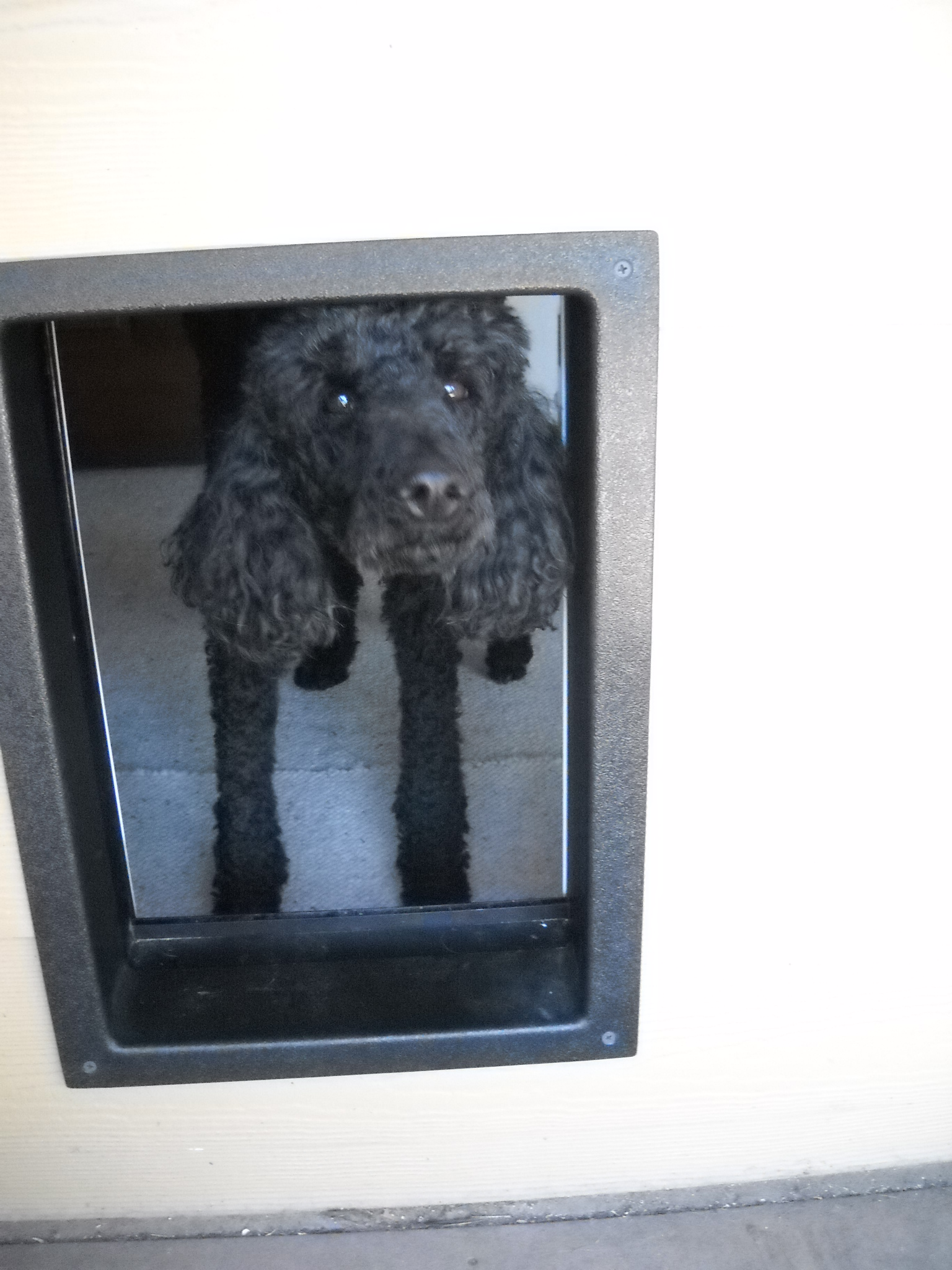
The real transformation came, though, when our automatic dog door — the same model we have in our Florida house — was ready for use. We solemnly attached the magnet-keys to each dog’s collar and turned on the magic portal. Wylie, Jana, and Oriel knew just what to do and were delighted to once again have free access to the outdoors (see A Doorway to Your Dog’s Independence).

To Molly, though, this was all new. She watched the others go in and out. She put her head through the open door and quickly pulled it back in. A gentle nudge convinced her to step gingerly through. She still wasn’t ready to try this on her own.

Armed with some of her favorite bison treats, I held a short introductory session. Jana eagerly demonstrated opening the door, walking through, and eating a treat on the other side. (She was especially eager to demonstrate the treat part.) I lured Molly through, made a huge fuss over her, and served up the yummy reward.

This was fun!

Oh, THIS is how it works!

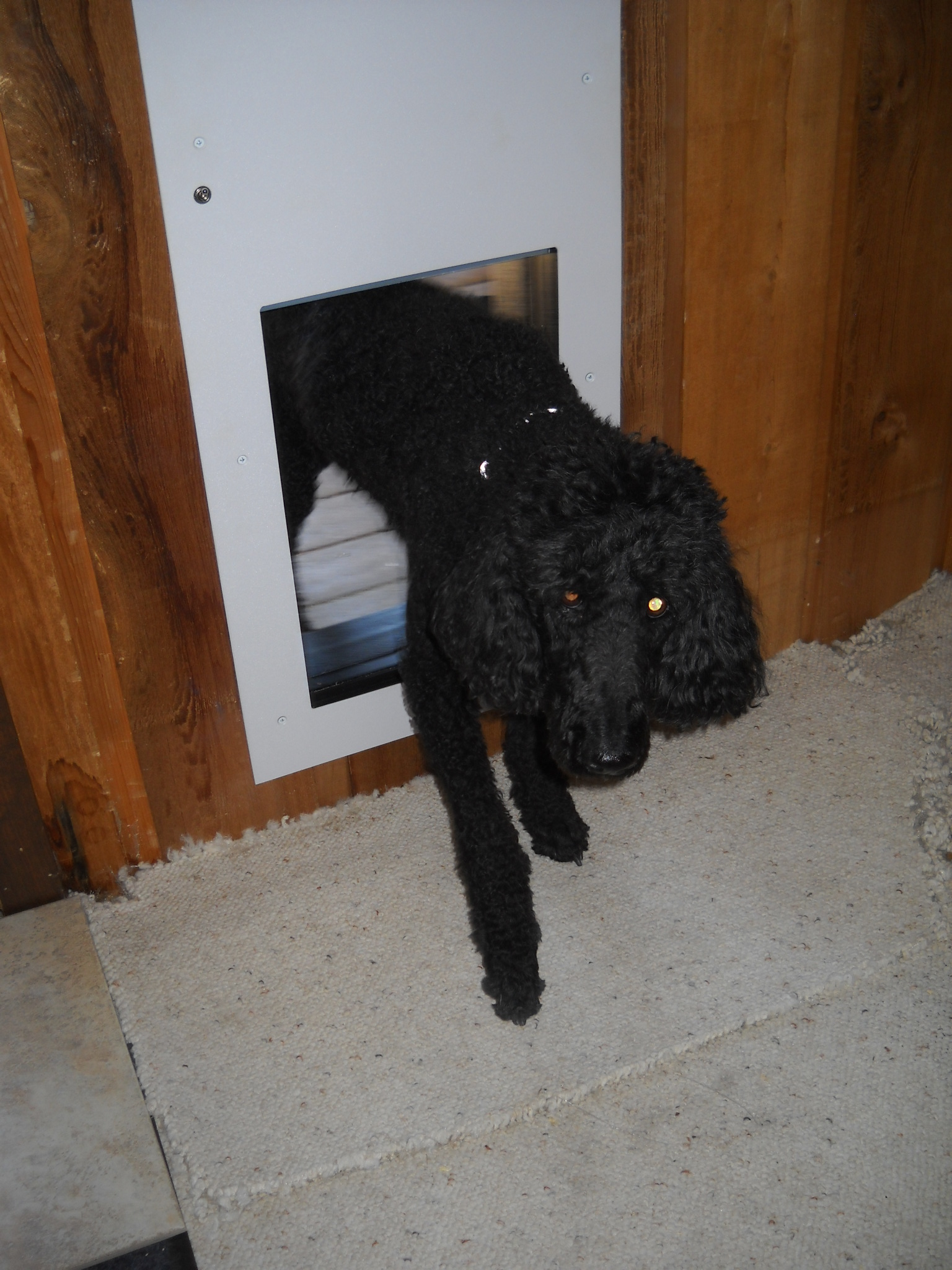
Molly tried again, and again, in, out, in — with my encouragement and rewards. I ended the session and decided to wait and see what she’d do next. Jana let herself out. The door closed. Molly approached cautiously, her magnet-key dangling from her collar. The door opened. Molly stepped through! Hooray!

Molly very quickly grew to love her new power. She stood taller. She pranced.

And she went in and out, in and out, several times a day over the next couple of days. Just because she could.

Jana, Oriel and Wylie to try Pilates

This slideshow requires JavaScript.

We’re about to get serious about getting in shape. Dog shape, that is. Jana, Oriel and even Wylie are about to take up the pooch equivalent of Pilates.

It’s called FitPAWS K9 Conditioning, and it is the latest, hippest way for dogs to work their core muscles and get in shape for serious athletics — agility, flyball, Frisbee, dock diving. Whatever your dog’s sport, our friend Val Minnis, who teaches FitPAWS and owns the K9BODYSHOP in Camarillo, California, says that the conditioning will help your dog achieve peak performance. That’s Val and Lexi, a buddy of Jana’s, demoing FitPAWS in the photos.

FitPAWS K9 Conditioning is also great for those weekend athletes who really feel stiff come Monday morning, for dogs who have had surgery or suffered an injury and even for elderly or arthritic dogs. According to Val, the gentle conditioning tones muscles without risking over-exertion or re-injury.

So what is FitPAWS, anyhow? Well, picture an oblong exercise ball. Picture your dog perched on top of it, perhaps doing puppy pushups (sit, down, sit, down …) or turning her head from side to side to ever-so-gently take treats from your hands. While doing these exercises, the dog’s weight is shifting and the dog is getting an excellent core workout just by maintaining her balance on the ball.

FitPAWS equipment comes in peanut, donut and egg shapes (this is supposed to get us in shape?), large and small discs, as well as other balance tools such as balance pads, pods, rocker boards, and more. Workouts can focus on one or more limbs (great for rehab after an injury) or overall conditioning.

During a typical session, Val uses treats, luring, and other encouragement to entice the dogs to place first one, then two or even all four paws onto a piece of equipment. Some dogs jump right on; others are very tentative. By the end of a session, though, nearly all the dogs are eager for more. K9 Conditioning sessions are intended to be fun for the dogs, and the dogs should be allowed to set the pace. Val never uses force (of course not; good trainers know that that’s never necessary) but encourages dogs to progress at their own pace.

The potential benefits go beyond improved athletic performance. Dogs can increase body awareness and confidence, increase their range of motion, improve balance and coordination and increase strength and flexibility. It also sounds like a great way for humans and dogs to have fun together. I’ll let you know what Jana, Oriel and Wylie think — just as soon as our equipment arrives!

Read CL posts!

I’m no longer posting on the Creative Loafing site but you can read all of my posts (about a year’s worth!) here: Thinking Dog posts

Jana and the Orbee Treat Ball

The day Jana defeated her Orbee treat ball, she proved to me, once and for all, that in raising her I broke my rule (the one that says you should never have a dog who is smarter than you are).

Orbee material, made by Planet Dog, is practically indestructible. The Orbee ball is hollow and has a hole about the size of a nickel. The ball is squishable. In my ceaseless quest to find ways to entertain and challenge Jana — who will do anything for food — I figured out that if I forced a large, hard dog biscuit through the hole in her Orbee ball, I could keep Jana entertained for up to an hour. Since she can empty even the most intricately, complex, frozen solid filled Kong in a few minutes, this was a very valuable discovery indeed.

What Jana did was lie on her back, put the ball in her mouth, and chomp hard enough on it to squash it and break the biscuit into small pieces, small enough that they’d come out the hole. That was pretty clever, but what she did next really amazed me: She lay on her back with the ball between her front paws. She squashed away. Then, I noticed her holding the ball out in front of her face and peering at it. She’d then turn it around with her paws, and look again. I realized she was looking for the hole. When she saw it, she turned the ball so the hole was right over her mouth, opened her mouth, and dumped the cookie pieces in. (Check out the video on my Facebook page.)

Then she nonchalantly kept chomping, squashing, and snacking, as if forcing me to re-think everything I knew about dog intelligence as compared with human intelligence was no big deal. This happened  a few years ago, and Jana still loves her Orbee. And anything else connected with food.

Now, Planet Dog is having a contest called “I love my Orbee.” Jana is a finalist. Soon, all of Jana’s friends (that’s YOU guys) can vote for her. You have to be on Facebook, I think. Details will come soon. If you are on Facebook, visit Planet Dog’s page.